0
0
 0
0

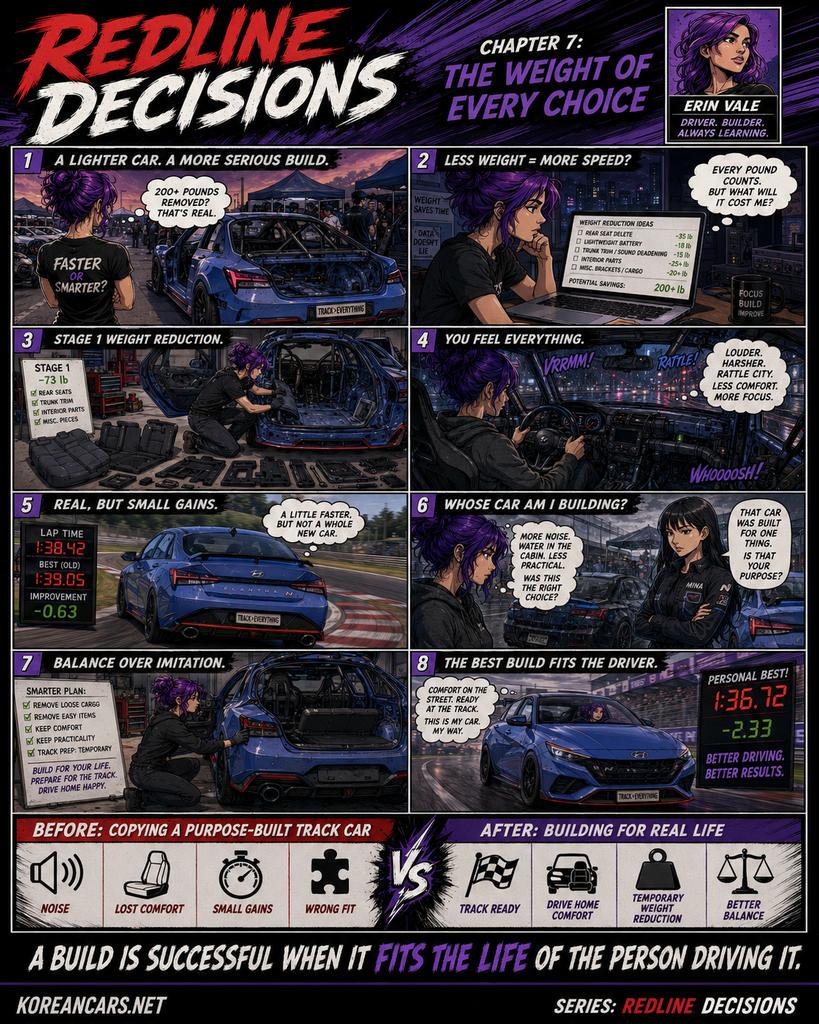
The stripped Elantra N was impossible to ignore.
It sat near the centre of the paddock with its doors open and its hood raised, surrounded by people who leaned close enough to study every missing piece.
No rear seats.
No carpet.
No trunk lining.
No sound insulation.
A fixed-back racing seat replaced the factory driver’s seat. A black roll bar crossed the empty rear cabin, and bare painted metal reflected the afternoon sun.
Even standing still, the car looked fast.
Erin Vale circled it slowly.
The owner, a broad-shouldered man named Caleb, noticed her looking through the passenger door.
“Two hundred and twelve pounds removed,” he said.
Erin turned toward him.
“From an Elantra N?”
“Anything that didn’t make it faster had to go.”
He tapped the bare metal where the rear seat had once been.
“Rear seats, carpet, trim, stereo components, sound deadening, factory battery. Even replaced some brackets.”
Erin crouched beside the open door.
The inside looked less like a road car and more like machinery.
“How much difference did it make?”
Caleb smiled.
“You feel everything.”
That was not quite the answer she had asked for.
But it sounded convincing.
Later that afternoon, Erin watched Caleb’s car enter the track.
It changed direction sharply and accelerated with almost no visible hesitation. The exhaust echoed through the empty cabin, making the car sound louder and more violent than the others.
When it passed the pit wall, Erin felt the engine note in her chest.
Her own Elantra N sat behind her.
Blue paint shining.
Interior intact.
Air conditioning working.
Factory seats comfortable enough for the drive home.
For the first time, all of that looked excessive.
Heavy.
Soft.
Compromised.
She opened the lap-timing results on her phone.
Caleb’s best time was nearly four seconds faster than hers.
Erin knew the difference could not be explained by weight alone. Caleb had more experience, more aggressive tires, upgraded suspension and a car prepared almost exclusively for the circuit.
Still, her mind isolated the most visible difference.
His car had less.
Therefore, it was faster.
That night, Erin opened another collection of browser tabs.
Elantra N rear-seat delete
How much does Elantra N interior weigh?
Lightweight battery track car
Remove sound deadening without dry ice
Is weight reduction better than horsepower?
The numbers were seductive.
Thirty pounds from the rear seats.
More from the passenger seat.
Another twenty-five from a lightweight battery.
Carpet, trim, spare tools, floor mats and trunk panels added several more.
Every removed object became measurable progress.
Unlike horsepower claims, weight reduction could not be argued with.
A pound removed was a pound removed.
She found photographs of immaculate stripped interiors painted in body colour. Roll cages. Harnesses. Aluminium door panels.
One forum member had written:
“The cheapest horsepower is the weight you don’t carry.”
Another replied:
“If you still have rear seats, you’re not serious.”
Erin read that sentence twice.
Serious.
The word made comfort sound like weakness.
She looked toward the garage door.
Her Elantra sat on the other side.
Perhaps she had been treating it too much like a street car.
Perhaps that was why her progress had slowed.
The following morning, Erin began with the trunk.
The floor panel came out easily.
Then the foam organizer.
The emergency kit.
The small collection of tools she carried.
The trunk trim required more patience. Plastic clips resisted until they released with sharp snapping sounds that made her worry something had broken.
Soon, bare metal appeared around the rear wheel wells.
Erin stepped back.
The trunk looked larger.
More purposeful.
She weighed everything she had removed.
Twenty-one pounds.
The number felt like a victory.
She entered it into a spreadsheet.
Stage 1 weight reduction: –21 lb
Then she removed the rear seat cushion.
A few bolts.
A hard pull.
The seat released.
The backrest followed.
The cabin changed immediately.
Without the rear seats, the car no longer looked unfinished.
It looked committed.
Erin photographed the interior and sent the picture to Mina.
Erin: Starting the weight-reduction phase.
Mina replied several minutes later.
Mina: Phase?
Erin: Rear seat and trunk delete first. Lightweight battery next.
Mina: Do you use the rear seats?
Erin stared at the question.
Erin: Not on the track.
Mina: That wasn’t the question.
Erin put the phone down.
By evening, seventy-three pounds of interior sat along the garage wall.
Seats.
Carpet sections.
Panels.
Brackets.
Fasteners arranged in labelled bags.
The Elantra’s interior now amplified every sound.
The closing door rang through the cabin.
The fuel pump hummed more loudly.
Small stones striking the underside sounded like handfuls of gravel thrown against sheet metal.
Erin started the engine.
The exhaust note filled the car.
She smiled.
Caleb had been right.
She could feel everything.
She drove around the block.
At low speed, the car seemed eager. Every vibration arrived more clearly through the seat and floor.
The sensation felt mechanical.
Raw.
Authentic.
At the first traffic light, a loose clip somewhere in the rear cabin began to rattle.
Erin ignored it.
Race cars rattled.
On Saturday, she drove across the city to meet Mina for coffee.
The highway journey lasted forty minutes.
By the halfway point, Erin understood what two hundred pounds of missing insulation might eventually feel like.
Even with only part of the interior removed, tire noise filled the cabin. The exhaust droned steadily at cruising speed. Water sprayed beneath the car as she passed through a shallow puddle, sounding far more dramatic than it was.
The rattle behind her became intermittent.
Then constant.
She turned up the stereo.
The stereo now sounded strangely empty without the rear trim helping contain the sound.
At the coffee shop, Mina walked around the car and looked through the rear window.
“You actually did it.”
“Seventy-three pounds.”
“Did you weigh the bolts?”
“Some of them.”
Mina opened the rear door.
The missing seat exposed painted metal, wiring and mounting points.
“What happens when you need to carry someone?”
“I rarely carry anyone.”
“Rarely isn’t never.”
Erin closed the door.
“It’s a track build.”
“It’s also the car you drove here.”
Erin crossed her arms.
“You don’t think weight reduction works?”
“Of course it works.”
“Then what’s the problem?”
Mina leaned against the roof.
“There isn’t a problem if this is what you want.”
“It is.”
Mina looked at her carefully.
“Is it what you want, or what a faster driver’s car made you think you should want?”
The question irritated Erin because it resembled one she had already learned to ask.
She had copied alignment numbers once.
Now she might be copying an entire philosophy.
The next track day should have proved the modification worthwhile.
Erin arrived expecting the Elantra to feel transformed.
The car was lighter.
The fuel load was carefully measured.
The rear seat and trunk contents remained in the garage.
She had even removed the passenger-side floor mat.
The first acceleration onto the circuit felt strong.
But it had felt strong before.
Through the opening corners, the car changed direction cleanly.
But it had done that before too.
Erin searched for the difference.
Under hard braking, perhaps the car slowed with slightly less effort.
On corner exit, perhaps the engine pulled with slightly more urgency.
The improvement was real enough to exist.
It was not large enough to announce itself.
At the end of the session, Erin checked the data.
Her best time was two-tenths quicker than her previous morning session.
Two-tenths mattered.
But track conditions were also cooler. Traffic had been lighter. Her driving had been clean.
The weight reduction might have helped.
The data could not tell her exactly how much.
Caleb approached while she reviewed the results.
“Saw the interior,” he said. “Good start.”
“Seventy-three pounds.”
“Still plenty left.”
Erin looked toward his stripped car.
“What would you remove next?”
“Passenger seat. Audio system. Air conditioning if you’re serious.”
“Air conditioning?”
“Compressor, condenser, lines. It all adds up.”
Erin imagined the drive to the track in July.
Caleb continued.
“Then lighter doors, polycarbonate windows, fixed-back seat, lightweight exhaust. You can lose another hundred without getting too extreme.”
Erin glanced through the open driver’s door of her car.
Without the rear interior, the Elantra already appeared less welcoming.
“What about driving it on the street?”
Caleb shrugged.
“You get used to it.”
During the second session, the sky darkened.
Rain began lightly, then strengthened.
The bare rear cabin amplified every drop against the roof and wheel wells. The sound became so loud that Erin struggled to distinguish tire noise from rainfall.
Visibility decreased.
She slowed appropriately.
The stripped interior did not make the car dangerous, but it changed the experience. Every sound suggested urgency.
The car felt restless even when it was stable.
After three laps, Erin returned to the paddock.
Water had entered around one of the loosened trunk-panel clips and collected in a shallow channel near the rear wheel well.
Only a small amount.
Nothing serious.
But the sight bothered her.
The parts she had removed had not merely added weight.
Some had managed noise.
Some had protected wiring.
Some had contained water.
Some had made the car pleasant enough to use regularly.
Not every component existed because Hyundai’s engineers had forgotten about performance.
Compromise was not always carelessness.
Sometimes it was design.
The rain ended the event early.
Erin began the drive home in damp clothes.
The highway was covered in standing water. Spray from larger vehicles struck the exposed rear wheel wells with a roar.
After twenty minutes, the sound became exhausting.
She turned off the stereo.
Then turned it back on.
The cabin no longer felt like a machine built for competition.
It felt like a street car missing pieces.
At a red light, Erin looked into the rear-view mirror.
Nothing occupied the space behind her except bare metal and loose seatbelt straps.
The visual was dramatic.
The reality was inconvenient.
She thought about removing the passenger seat next.
Then the stereo.
Then the air conditioning.
Each change would make the car more specialized.
Each change would also reduce the number of situations in which she would enjoy it.
She asked herself a question she should have asked before touching the first bolt.
What was the car for?
Track days, yes.
But also late-night drives.
Coffee runs.
Trips outside the city.
Car meets.
Occasional passengers.
The Elantra was not transported to the circuit on a trailer.
It carried its own tires, tools and driver.
It had to survive traffic before it could chase lap times.
Erin had been trying to turn a dual-purpose car into someone else’s dedicated machine.
On Monday evening, she returned to the garage.
The removed interior remained stacked against the wall.
She picked up the rear seat cushion.
It felt heavier now that she understood exactly what it provided.
Comfort.
Sound control.
Utility.
A finished cabin.
She began reinstalling the car.
Not everything returned.
The heavy trunk organizer stayed out for track events.
The emergency tools went into a lighter, compact bag.
Unnecessary items remained on the shelf.
But the rear seats returned.
The carpet returned.
The trim returned.
Erin cleaned each piece before reinstalling it, replacing damaged clips and adding small strips of anti-rattle material where the panels had previously moved.
The process took longer than removal.
Building usually did.
When she finished, the interior looked nearly standard.
Erin sat in the driver’s seat and closed the door.
The cabin became quiet.
Not silent.
Controlled.
She started the engine.
The exhaust remained audible, but it no longer dominated the space.
The car felt whole again.
At the next track event, Erin arrived with a more deliberate strategy.
The rear seats were installed for the drive.
Her tools and track supplies remained secured in the trunk.
Once in the paddock, she removed only what could be removed easily and replaced safely before leaving.
Loose cargo.
The tool bag.
The floor mats.
The spare items she did not need on circuit.
Temporary weight reduction.
No permanent sacrifice.
Mina watched as Erin organized the trunk.
“No passenger-seat delete?”
“No.”
“No air-conditioning removal?”
“Definitely no.”
Mina smiled.
“So the serious phase is over?”
Erin shook her head.
“I’m taking it more seriously now.”
She pointed toward the car.
“It has to work for the track without becoming useless everywhere else.”
“That sounds dangerously reasonable.”
“I’m trying something new.”
The day went well.
The Elantra did not feel dramatically heavier with the interior restored.
Erin’s lap times remained competitive with her previous event. In the afternoon, she set a personal best by improving her line through two connected corners.
Not by removing more weight.
Not by buying another part.
By driving better.
When the final session ended, she reloaded the car, turned on the air conditioning and left the circuit.
The highway journey was calm.
The cabin remained quiet enough for music.
Her helmet rested on the rear seat.
The tool bag remained secured in the trunk.
The Elantra still carried the dust and heat of the racetrack, but it had become a road car again with the closing of a door.
That transformation was not evidence of compromise.
It was the reason Erin had chosen the car.
Weeks later, she saw Caleb again.
His Elantra had arrived on a trailer.
The passenger window was now fixed polycarbonate. The dashboard had been partially cut. The air-conditioning system was gone.
It was lighter.
Faster.
More focused.
And for Caleb, it made sense.
“This is what the car is for,” he explained.
Erin nodded.
She finally understood that his choices were not wrong.
They simply belonged to his goals.
Her mistake had been assuming that dedication had only one appearance.
For Caleb, dedication meant removing everything that did not improve lap time.
For Erin, it meant creating a car she could drive to the track, learn from all day and still enjoy on the way home.
Neither build was dishonest.
Only a build disconnected from its owner’s real life was dishonest.
That night, Erin updated her modification spreadsheet.
She deleted the column labelled:
Maximum possible weight reduction
In its place, she created two new columns:
Track benefit
Daily cost
Every future modification would have to answer both.
She entered the rear-seat delete.
Track benefit: small.
Daily cost: moderate.
Decision: not permanent.
Then she added another note beneath the table:
The lightest car is not automatically the best car for its owner.
Erin closed the laptop.
Outside, the Elantra waited beneath the garage light.
Not stripped.
Not compromised.
Balanced.
The same quality she had spent months learning to find in herself.
Final Line
“A build is successful when it fits the life of the person driving it.”
End of Chapter 7