0
0
 0
0
What actually kills builds—and how to avoid becoming another cautionary story
Editor’s Note
Turbocharging a Hyundai—whether it’s a Hyundai Genesis Coupe, Hyundai Elantra N, or even an older Hyundai Tiburon—can unlock serious performance.
But it also introduces something else:
👉 risk
Because most blown engines don’t happen randomly.
They happen because of avoidable mistakes.
And the worst part?
Most of them come from chasing power the wrong way.
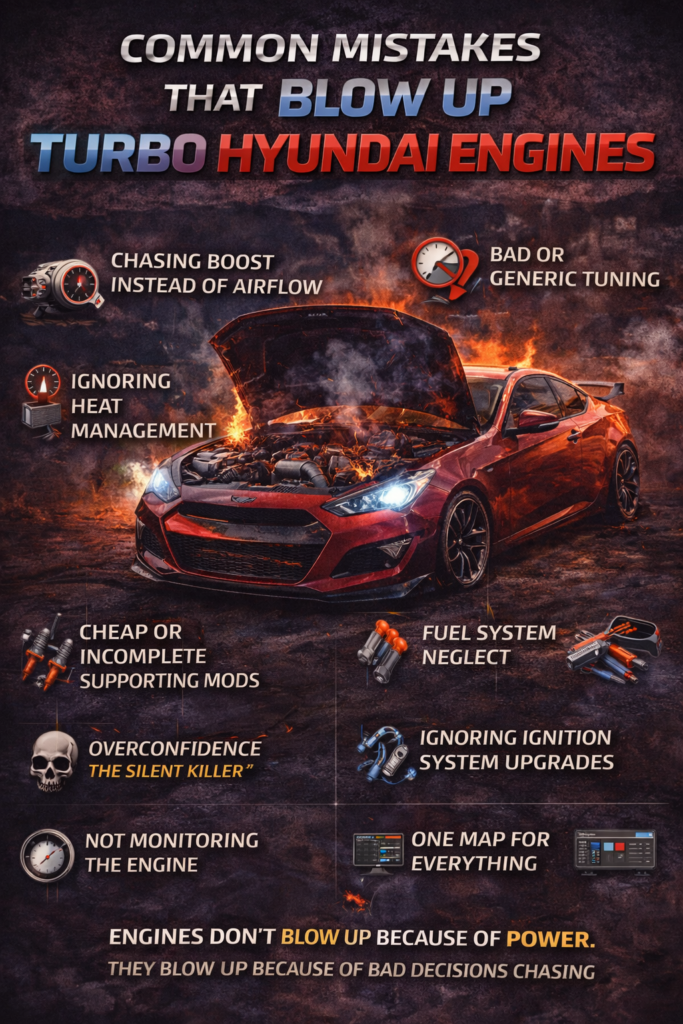
💣 1. Chasing Boost Instead of Airflow
We just covered this—but it’s the #1 killer.
People think:
“More PSI = more power”
So they:
- crank boost on stock turbo
- push beyond efficiency range
- generate massive heat
Result:
👉 knock, detonation, engine damage
🔥 Reality:
- inefficient boost = hot air
- hot air = less oxygen
- less oxygen = unstable combustion
👉 Boom.
⚠️ 2. Bad or Generic Tuning
This is where most builds fail.
Running:
- off-the-shelf tunes
- poorly calibrated maps
- “close enough” AFRs
…on a turbo build is dangerous.
Especially on platforms like the Hyundai Genesis Coupe.
Common tuning issues:
- lean AFR under boost
- too much ignition timing
- inconsistent fueling
👉 All of these lead to engine knock.
🔑 Rule:
Your tune matters more than your parts.
🌡 3. Ignoring Heat Management
Turbo = heat.
And Hyundai engines—especially when pushed—are sensitive to it.
What people skip:
- oil coolers
- proper intercooling
- heat shielding
What happens:
- oil breakdown
- heat soak
- inconsistent power
- eventual failure
👉 Heat doesn’t just reduce performance.
It destroys engines over time.
🔧 4. Cheap or Incomplete Supporting Mods
This is the “budget trap.”
People spend on:
- turbo
- intake
- exhaust
…but skip:
- fuel system
- ignition
- cooling
Result:
- engine can’t support new power
- system becomes unbalanced
👉 Weak link fails first.
⚠️ Example:
- upgraded turbo
- stock fuel pump
👉 lean condition → engine damage
⛽ 5. Fuel System Neglect
More power = more fuel required.
Simple.
Common mistakes:
- stock injectors
- weak fuel pump
- poor fuel quality
Result:
👉 engine runs lean under boost
And lean + boost =
💣 engine failure
🧠 6. Overconfidence (The Silent Killer)
This one’s psychological.
People think:
- “It’s fine”
- “It’ll hold”
- “I’ll upgrade later”
Meanwhile:
- AFR is slightly off
- temps are slightly high
- timing is slightly aggressive
👉 And those “slight” issues add up.
🔌 7. Ignoring Ignition System Upgrades
Spark is often overlooked.
But under boost, ignition becomes critical.
Problems:
- weak spark
- misfires
- incomplete combustion
Solutions:
- better spark plugs
- upgraded coils
👉 Small upgrade. Huge impact.
🧪 8. Not Monitoring the Engine
This is one of the biggest differences between:
- safe builds
- blown builds
If you’re not watching:
- AFR
- temps
- boost levels
You’re guessing.
Tools matter:
- wideband AFR gauge
- proper ECU logging
👉 What you don’t see can destroy your engine.
⚙️ 9. One Map for Everything
Running one tune for:
- daily driving
- aggressive pulls
- different weather
👉 is not ideal
Better approach:
- conservative daily map
- aggressive performance map
This reduces stress and increases reliability.
🚫 10. Pushing Stock Internals Too Far
At some point:
👉 hardware limits exist
Common mistake:
- chasing numbers beyond engine capability
Reality:
- rods, pistons, and components have limits
👉 Respect those limits—or pay for it.
🏁 Final Thoughts
Turbo Hyundai builds are powerful—but they demand respect.
Most blown engines don’t happen because the platform is weak.
They happen because:
👉 the build was incomplete
👉 the tuning was wrong
👉 the limits were ignored
🔥 Closing Line
Engines don’t blow up because of power.
They blow up because of bad decisions chasing power.
This type of article builds serious authority 🔥