0
0
 0
0
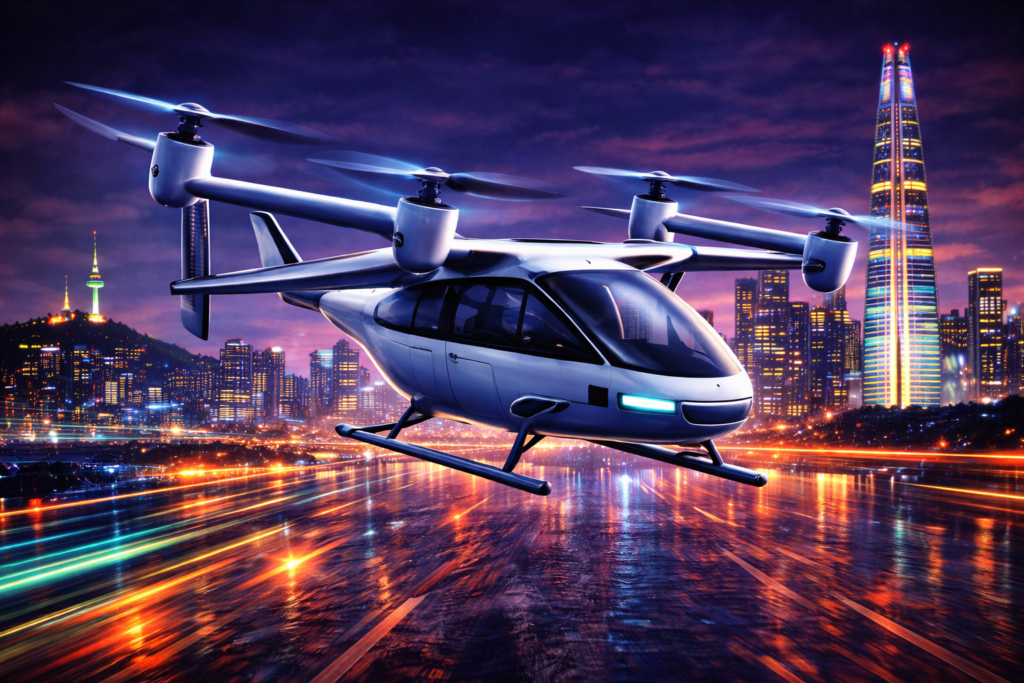
For decades, flying cars have existed in the realm of science fiction—symbols of a futuristic world where traffic disappears and cities become fully three-dimensional. Today, that vision is rapidly becoming reality, and Korea is positioning itself at the forefront of this transformation.
Through bold investments, advanced engineering, and a unified national strategy, Korea is shaping the future of urban air mobility (UAM)—a new ecosystem where vehicles move seamlessly between ground and air.
What Is Urban Air Mobility?


Urban Air Mobility refers to the use of electric vertical takeoff and landing (eVTOL) aircraft to transport people and goods within cities and between urban centers.
Key Characteristics:
- Vertical takeoff and landing (no traditional runway needed)
- Electric propulsion for low emissions
- Autonomous or semi-autonomous operation
- Integration with existing transport systems
In simple terms, UAM is the evolution of transportation—from 2D roads to 3D mobility networks.
Korea’s Strategic Push into the Skies
Korea isn’t just experimenting with flying cars—it’s building a national framework to support them.
Government Initiatives:
- K-UAM Roadmap targeting commercialization by the late 2020s
- Partnerships between public and private sectors
- Development of vertiports (urban air hubs)
- Regulatory frameworks for safe deployment
The Korean government sees UAM as a key pillar of future economic growth and urban innovation.
Hyundai’s Vision: Leading the Charge
At the center of Korea’s UAM ambitions is Hyundai Motor Group.


Through its dedicated division Supernal, Hyundai is developing next-generation eVTOL aircraft designed for urban environments.
Key Goals:
- Safe, reliable passenger transport
- Quiet operation suitable for cities
- Seamless integration with ground mobility
- Commercial rollout within the next decade
Hyundai’s approach combines its automotive expertise with aerospace engineering—creating vehicles that are both practical and scalable.
Technology Behind Flying Cars
The success of UAM depends on several critical technologies:
1. Electric Propulsion
Lightweight, high-efficiency electric motors power eVTOL aircraft, enabling quieter and cleaner operation compared to traditional helicopters.
2. Battery Innovation
Advances in battery density and charging speed are essential for practical flight times and rapid turnaround.
3. Autonomous Systems
AI-driven navigation and flight control systems will reduce reliance on human pilots over time.
4. Air Traffic Management
New systems are being developed to manage low-altitude urban air traffic safely and efficiently.
Infrastructure: Building the Sky Highways


Flying cars require more than just vehicles—they need an entirely new infrastructure.
Key Components:
- Vertiports: Designated takeoff and landing hubs
- Charging Stations: High-speed electric charging for aircraft
- Integrated Transit Systems: Connections to trains, buses, and cars
- Digital Networks: Real-time traffic and safety management
Korean cities like Seoul are already exploring how to integrate these elements into urban planning.
Benefits of Urban Air Mobility
🚀 Reduced Traffic Congestion
By moving transportation into the air, UAM can significantly reduce road congestion.
⏱ Faster Travel Times
What takes an hour by car could take minutes by air.
🌱 Environmental Advantages
Electric propulsion reduces emissions compared to traditional transport.
🌐 Economic Growth
New industries, jobs, and technological advancements will emerge.
Challenges Ahead
Despite its promise, UAM faces several hurdles:
Safety and Regulation
Ensuring passenger safety is the top priority.
Public Acceptance
People must feel comfortable flying in urban environments.
Infrastructure Costs
Building vertiports and networks requires significant investment.
Battery Limitations
Energy density must improve for longer and more efficient flights.
Korea vs. the World
While countries like the United States and Germany are also investing in UAM, Korea’s strength lies in:
- Rapid infrastructure development
- Strong government-industry collaboration
- Advanced electronics and battery technology
- Integration with smart city initiatives
This positions Korea as a serious contender in the global race for aerial mobility.
The Future: A Seamless Mobility Ecosystem
Imagine this scenario:
You leave your apartment, take a short autonomous ride to a nearby vertiport, board an eVTOL aircraft, and arrive across the city in minutes—then seamlessly connect to another mode of transport.
This is the vision Korea is building toward:
- Connected mobility ecosystems
- Multi-modal transportation
- Smart, efficient cities
The boundaries between cars, aircraft, and public transit will blur into a unified system.
Conclusion
Flying cars are no longer just a dream—they are an emerging reality. And Korea is at the forefront of making that reality practical, scalable, and accessible.
Through innovation, collaboration, and bold vision, Korea is redefining what transportation can be—not just on the ground, but in the air.
The future of mobility isn’t just faster or cleaner—it’s multi-dimensional.
And if Korea’s vision becomes reality, the next time you think about traffic, you might just look up.