0
0
 0
0
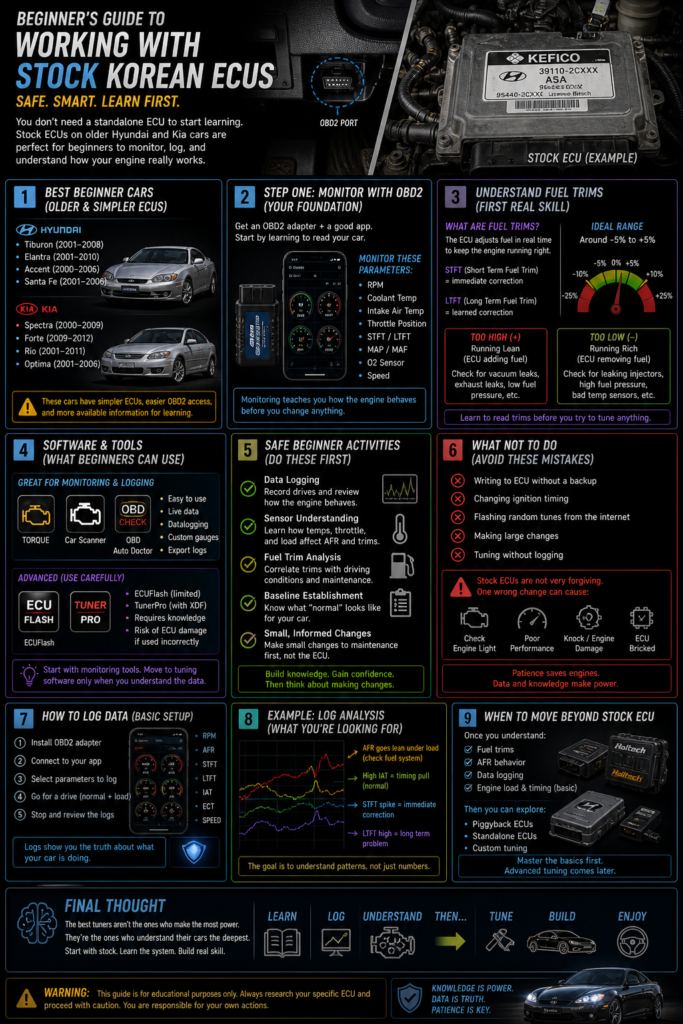
If you’re getting into ECU work, you don’t need to jump straight into a standalone system.
In fact:
👉 The smartest place to start is with stock ECUs—especially on older Hyundai and Kia models.
They’re:
- Simpler
- More forgiving
- Well-documented (relatively)
But you still need to approach this carefully.
This guide will show you what’s safe, what tools to use, and where beginners should actually start.
🧠 1. What “Working with Stock ECUs” Really Means


You are NOT:
- Rewriting the entire ECU
- Building custom maps from scratch
You ARE:
- Reading data
- Logging behavior
- Possibly making light adjustments (if supported)
👉 Think of this as learning the system—not hacking it.
🚗 2. Best Beginner-Friendly Korean Cars (Stock ECU Work)
Not all ECUs are equal.
Start with older, simpler platforms like:
- Early 2000s Hyundai Tiburon
- Hyundai Elantra (2001–2010 range)
- Kia Spectra / Forte (older generations)
Why these?
👉 They use:
- Simpler ECUs
- More accessible OBD2 data
- Less locked-down software
Newer cars (especially turbo + modern ECUs):
- Much more encrypted
- Harder to access safely
🔌 3. Step One: Learn OBD2 Monitoring (Your Foundation)


Before anything else:
👉 Get an OBD2 scanner
Recommended beginner setup:
- Bluetooth OBD2 adapter
- Smartphone app
Popular apps:
- Torque (Android)
- Car Scanner
- OBD Auto Doctor
What to monitor:
- RPM
- Coolant temp
- Intake air temp
- Throttle position
- Short-term / long-term fuel trims
👉 This is your “training ground.”
📊 4. Understanding Fuel Trims (Your First Real Skill)


Fuel trims tell you how the ECU is adjusting fuel.
- STFT (Short Term Fuel Trim) → immediate correction
- LTFT (Long Term Fuel Trim) → learned behavior
👉 Ideal range:
- Around -5% to +5%
If you see:
- +10% or more → running lean (adding fuel)
- -10% or more → running rich (removing fuel)
👉 This teaches you how the ECU thinks
🧰 5. Can You Actually Tune Stock ECUs?
Short answer:
👉 Sometimes—but limited
Older Korean ECUs can be:
- Read-only (monitoring only)
- Or lightly adjustable with the right tools
But:
⚠️ Most stock ECUs are not beginner-friendly for full tuning
⚠️ Writing to them can brick the ECU if done wrong
💻 6. Software Options (Beginner-Friendly)


Here’s what you can safely use:
✅ Monitoring & Logging (Best for beginners)
- Torque
- Car Scanner
- OBD Auto Doctor
⚠️ Advanced (Use carefully)
- ECUFlash (limited compatibility)
- TunerPro (requires definition files/XDFs)
👉 These require:
- Proper ECU definitions
- Knowledge of what tables mean
Not plug-and-play.
🔍 7. Safe Beginner Activities (Do These First)
Focus on:
✔ Data logging
- Record drives
- Observe behavior under load
✔ Sensor understanding
- How temps affect performance
- How throttle changes AFR
✔ Maintenance correlation
- See how spark plugs, intake, etc. affect trims
👉 This builds real skill without risk.
🚫 8. What NOT to Do as a Beginner
Avoid:
❌ Writing to ECU without backup
❌ Changing ignition timing
❌ Flashing random tunes online
❌ Guessing map values
👉 Stock ECUs are not forgiving if you make bad changes.
🔧 9. When to Move Beyond Stock ECU
Once you understand:
- AFR behavior
- Fuel trims
- Data logging
Then you can consider:
- Piggyback systems
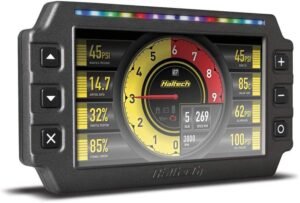
- Standalone ECUs (like Haltech)
👉 But not before.
🔥 Final Thought
Working with stock Korean ECUs is the perfect starting point.
Because:
👉 It teaches you how cars actually think.
Before you:
- Add power
- Change maps
- Build big setups
You need to understand:
- Data
- Behavior
- Patterns
The people who skip this step?
They guess.
The people who learn it?
👉 They build properly.