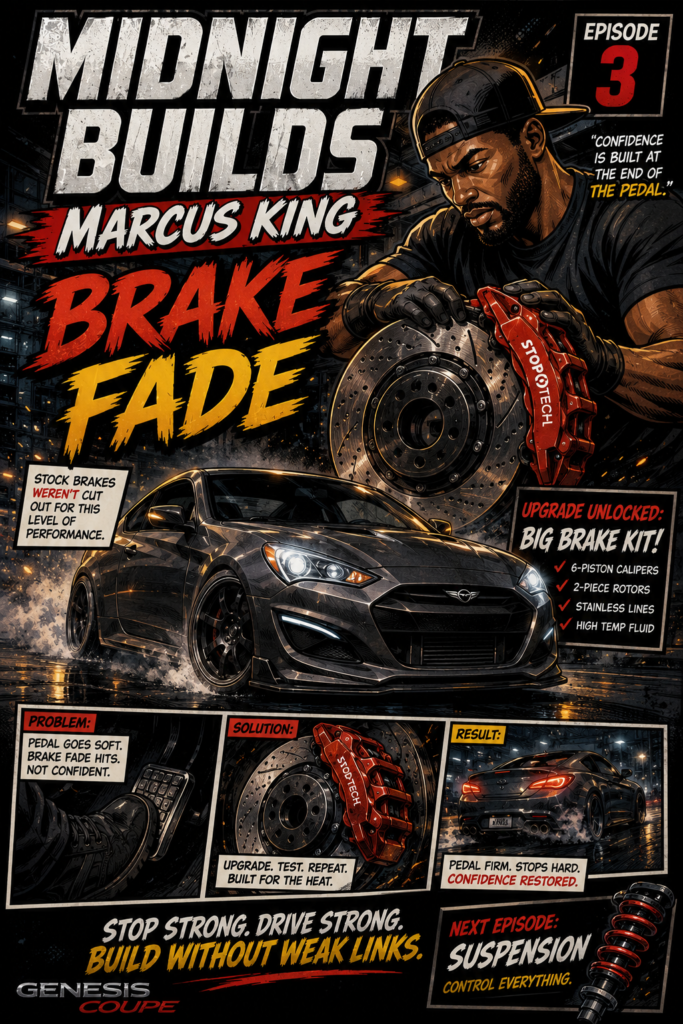
The car was finally coming together.
Boost?
Dialed.
Differential?
Upgraded.
Traction?
Perfect.
For the first time in months, Marcus felt like the Genesis Coupe wasn’t fighting him anymore.
It was becoming exactly what he envisioned.
Which is why what happened next caught him completely off guard.
The night air was cool as Marcus guided his Hyundai Genesis Coupe onto a long stretch of empty road outside Seoul.
Nothing crazy.
Just a few pulls to verify everything was working together.
Second gear.
Throttle in.
The turbo whistled.
The Genesis surged forward.
Third gear.
Fourth.
The car felt incredible.
Marcus smiled.
“Finally.”
Then he approached a curve.
Nothing dangerous.
Nothing unusual.
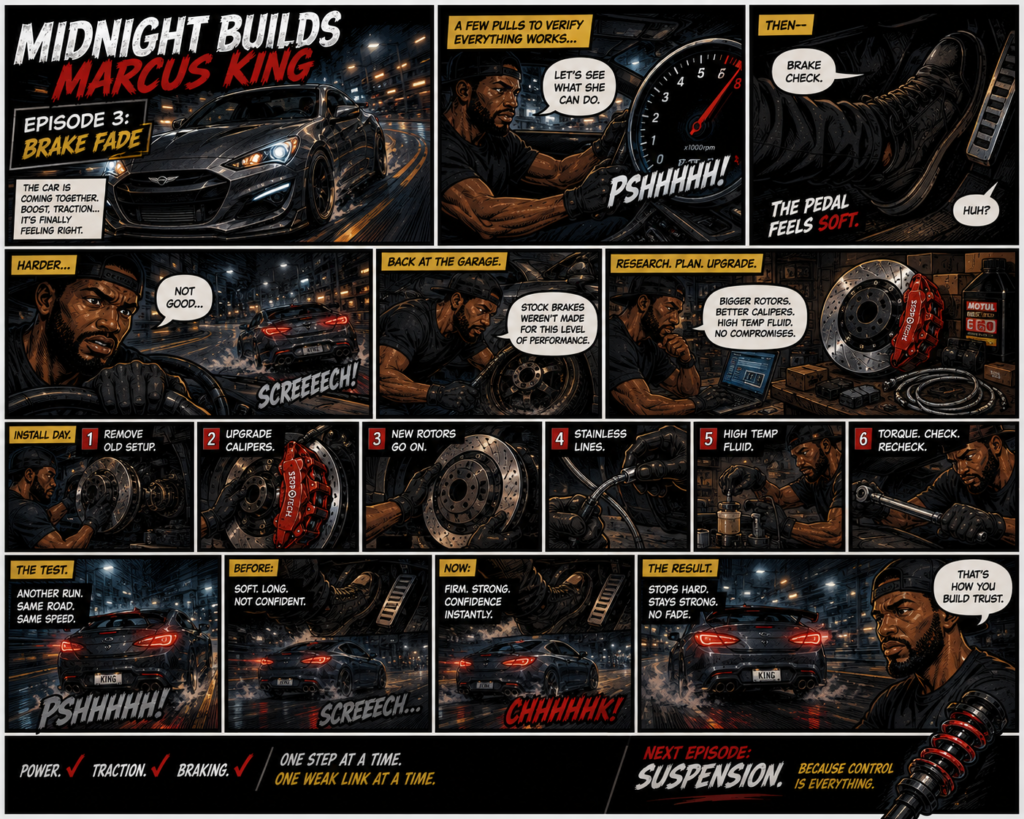
He moved his foot to the brake pedal.
Pressed.
The pedal felt…
Different.
Soft.
His eyes narrowed.
He pressed harder.
The car slowed.
But not nearly as aggressively as he expected.
“What the…”
The corner came faster.
Marcus smoothly increased pressure and guided the car through.
No panic.
No emergency.
But something was definitely wrong.
A few minutes later he pulled into a parking area overlooking the city lights.
The Genesis ticked quietly as it cooled.
Marcus sat there thinking.
Power had increased.
Grip had increased.
Speed had increased.
But the brakes?
Still mostly stock.
He laughed.
A short, disappointed laugh.
“Of course.”
The weakest link had moved.
Back in the garage, Marcus pulled off a wheel and stared at the front brakes.
Years of hard driving.
Countless heat cycles.
Factory-sized rotors.
Factory calipers.
Good enough for stock power.
Not good enough anymore.
Marcus opened his laptop.
Hours disappeared.
Forums.
Track-day data.
Brake temperature charts.
Rotor sizes.
Pad compounds.
Most people searched for horsepower.
Marcus searched for confidence.
Three days later, boxes began arriving.
One after another.
Performance rotors.
Stainless brake lines.
High-temperature fluid.
Six-piston front calipers.
Marcus smiled.
Christmas had arrived.
The installation wasn’t glamorous.
No giant turbo.
No flashy dyno graph.
Just careful work.
Brake fluid bled.
Lines tightened.
Rotor runout checked.
Torque specs verified.
Again.
And again.
And again.
Because brakes weren’t exciting.
Until you needed them.
The following night, Marcus returned to the same road.
Same conditions.
Same test.
The Genesis accelerated hard.
Boost singing.
Exhaust roaring.
Everything working together.
Then came the corner.
Marcus moved his foot.
Pressed the brake pedal.
Immediately—
The response was different.
Firm.
Direct.
Confident.
The nose settled.
The car slowed effortlessly.
No softness.
No hesitation.
No uncertainty.
Marcus couldn’t help smiling.
“There you are.”
He repeated the test.
Again.
And again.
And again.
The brakes never changed.
No fade.
No softness.
No complaints.
Exactly what he wanted.
Back at the garage, Marcus sat on a folding chair staring at the car.
The brake rotors still clicked softly as they cooled.
Most people thought building a car was about going faster.
Marcus was learning something different.
Every upgrade wasn’t about speed.
It was about removing fear.
Removing uncertainty.
Creating trust between driver and machine.
The Genesis wasn’t perfect yet.
Not even close.
But now?
It could accelerate.
It could corner.
And most importantly…
It could stop.
Marcus grabbed a marker and wrote on the whiteboard hanging beside his toolbox:
Power.
✓
Traction.
✓
Braking.
✓
Then he looked at the last empty line.
After a moment, he smiled.
And wrote:
Suspension.
The next challenge had already begun.