0
0
 0
0
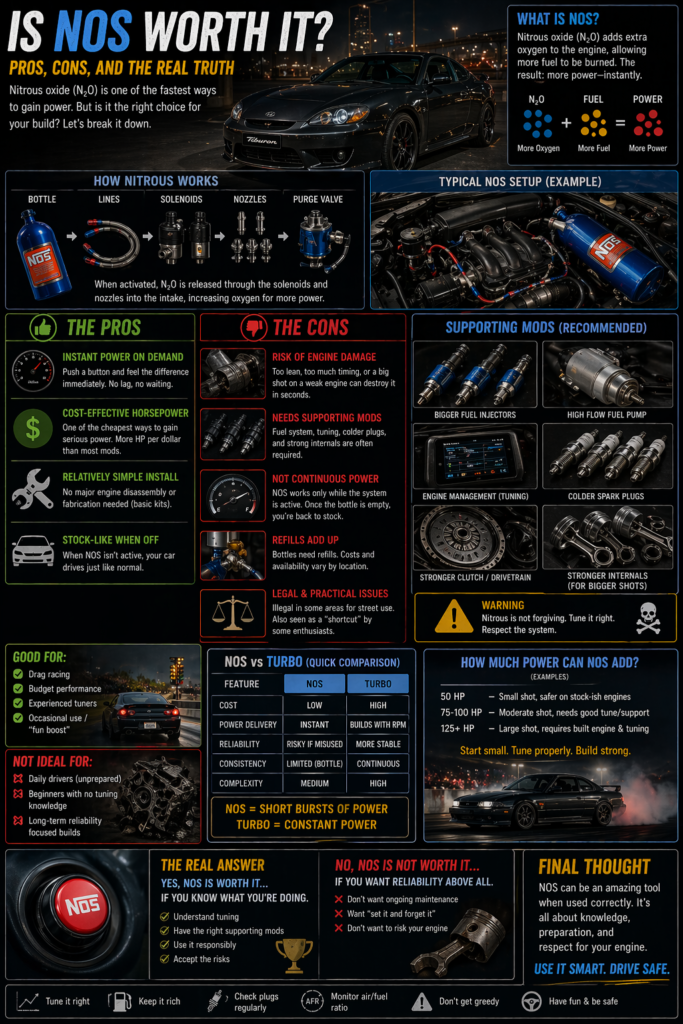
Nitrous oxide—better known as NOS—has one of the most iconic reputations in car culture. Thanks to movies like The Fast and the Furious, it’s often portrayed as a magic “boost button” that instantly transforms your car.
And to be fair…
👉 That’s not entirely wrong.
But the real question is:
Is NOS actually worth it for your build?
The answer depends heavily on your goals, your setup, and how well you understand the risks.
💨 What Is NOS (Nitrous Oxide)?


Nitrous oxide (N₂O) is a chemical compound that, when injected into your engine, increases the amount of oxygen available for combustion.
What That Means:
- More oxygen + more fuel = more power
- Cooler intake charge = denser air
- Instant horsepower increase
👉 It’s one of the cheapest ways to gain big power quickly.
🚀 The Pros of NOS
1. Instant Power on Demand
Unlike turbos or superchargers, NOS gives you:
- Power only when you want it
- No lag
- Immediate response
Hit the button—and you feel it.
2. Cost-Effective Horsepower


Compared to forced induction:
- Turbo setup: $$$$
- Supercharger: $$$$
- NOS kit: $
You can gain:
- +50 HP
- +100 HP
- Even more (with proper setup)
👉 Dollar-per-horsepower, NOS is hard to beat.
3. Simpler Installation (Relatively)
A basic kit involves:
- Bottle
- Lines
- Solenoids
- Injectors
No need for:
- Major engine disassembly
- Exhaust fabrication (like turbos)
4. Keeps Daily Driving Stock-Like
When NOS isn’t active:
- Your car behaves normally
- No extra stress (in theory)
- No constant boost
👉 It’s a “temporary power upgrade”
⚠️ The Cons of NOS
1. It Can Destroy Your Engine (If Done Wrong)


This is the biggest risk.
Common causes of failure:
- Running too lean
- No proper tune
- Too large a shot
- Weak engine internals
👉 NOS doesn’t forgive mistakes.
2. You Need Supporting Mods
To run NOS safely, you often need:
- Better fuel system
- Colder spark plugs
- Proper ECU tuning (e.g., Haltech Elite 750 ECU setups)
- Stronger internals (for bigger shots)
That “cheap mod” can escalate quickly.
3. It’s Not Continuous Power
NOS is:
- Limited by bottle size
- Only active for short bursts
Once the bottle is empty:
👉 You’re back to stock power.
4. Refilling Costs Add Up


- Refills aren’t free
- Availability varies by location
- Frequent use = ongoing cost
5. Social & Practical Downsides
- Illegal in some areas for street use
- Seen as “shortcut power” by some enthusiasts
- Can be overused or misused
🔧 Is NOS Good for Korean Cars?
For cars like:
- Hyundai Tiburon
- Hyundai Genesis Coupe
NOS can work—but:
You Must Consider:
- Engine strength (especially older engines)
- Tuning capability
- Fuel system limitations
👉 A small shot (e.g., 50 HP) is generally safer
👉 Big shots require serious preparation
🧠 NOS vs Turbo (Quick Comparison)
| Feature | NOS | Turbo |
|---|---|---|
| Cost | Low | High |
| Power Delivery | Instant | Builds with RPM |
| Reliability | Risky if misused | More stable long-term |
| Consistency | Limited | Continuous |
| Complexity | Medium | High |
🎯 Who Should Use NOS?
Good Fit:
- Drag racing builds
- Budget performance seekers
- Experienced tuners
- Occasional “fun boost” users
Not Ideal:
- Daily drivers with no backup
- Beginners with no tuning knowledge
- Long-term reliability-focused builds
🏁 The Real Answer: Is It Worth It?
👉 Yes, if:
- You understand tuning
- You use it responsibly
- You accept the risks
👉 No, if:
- You want reliability above all
- You don’t want ongoing maintenance
- You expect “set it and forget it”
Conclusion
NOS is one of the most powerful tools in car tuning—but also one of the most misunderstood.
It’s not magic.
It’s not free power.
It’s a high-risk, high-reward system that demands respect.
Used properly, it can transform your car.
Used carelessly…
👉 It can end your engine in seconds.