0
0
 0
0
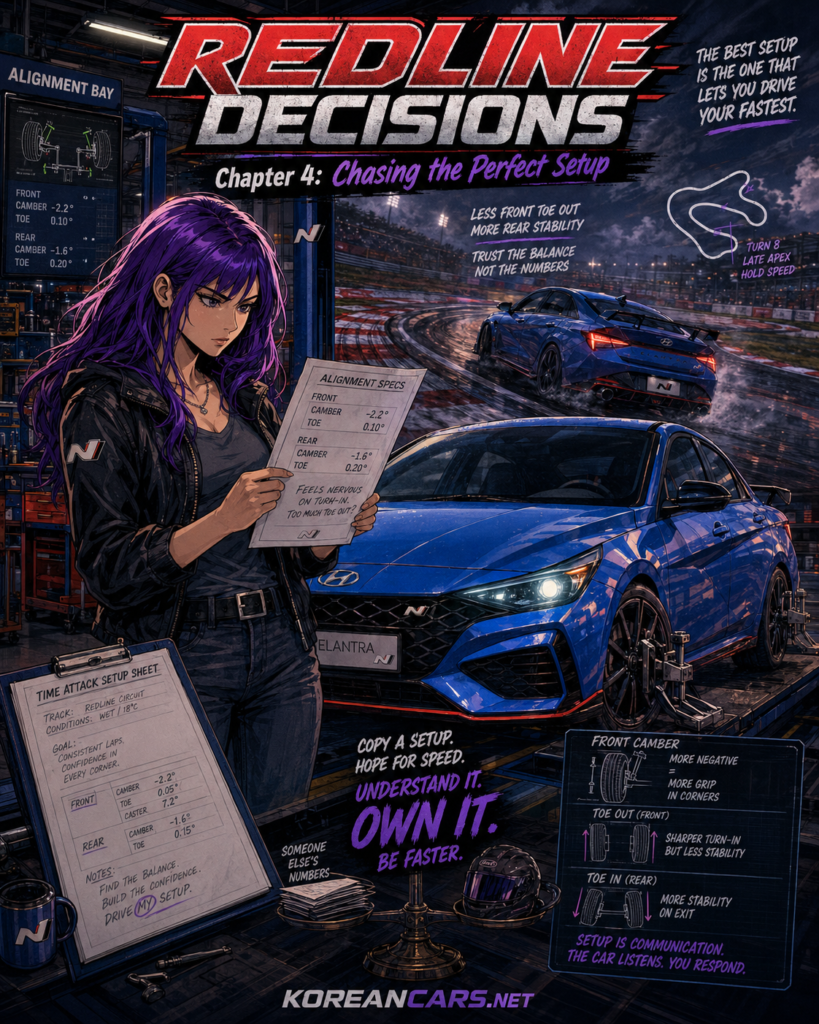
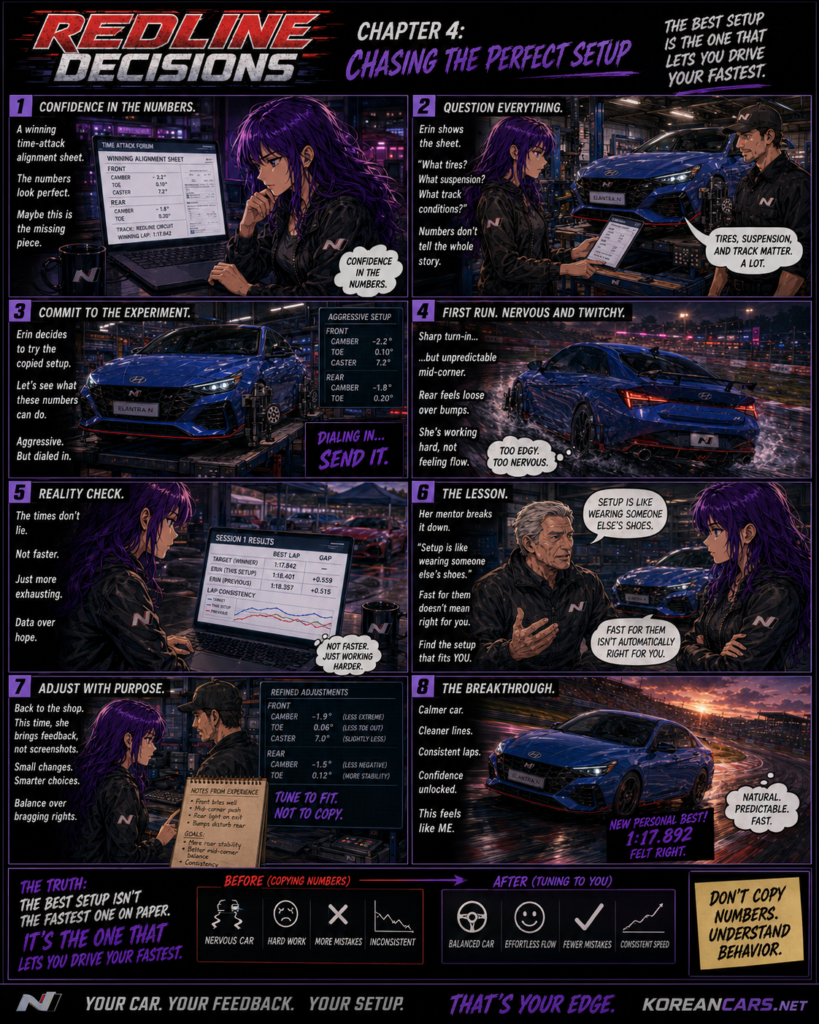
The screenshot looked authoritative.
That was the problem.
Erin Vale sat in front of her laptop with one knee pulled against her chest, purple hair loosely tied behind her head. On the screen was a photograph of an alignment sheet posted by a local time-attack driver.
The caption beneath it read:
Winning Elantra N setup. Copy these numbers and thank me later.
Erin leaned closer.
Front camber: –2.8 degrees
Rear camber: –2.0 degrees
Front toe: slight toe-out
Rear toe: near zero
The numbers looked precise enough to silence doubt.
They were not vague opinions about intake sound, throttle response, or whether a part “felt faster.” They were measurements. Angles. Decimal points.
Science.
At least, that was how they appeared.
The post had hundreds of comments.
“This setup transformed my car.”
“Best alignment for the Elantra N.”
“Turn-in is insane.”
“Factory settings are way too conservative.”
One commenter had written:
“If you track your car and you’re not running this, you’re leaving time on the table.”
Erin saved the screenshot.
Her blue Elantra N sat in the garage below, still carrying the lessons of the previous months.
The short ram intake had given it a sharper voice.
The performance tires had given it real grip.
The tune had given it more power—and forced her to become smoother, more deliberate, more respectful of the throttle.
Every modification had taught her something.
This alignment, she thought, might finally tie everything together.
Not just more speed.
Precision.
The performance shop smelled like rubber, metal, and warm brakes.
Erin stood beside the alignment rack while a technician studied the screenshot on her phone. His name was Daniel, a quiet man in his forties with grease permanently settled into the lines of his hands.
He enlarged the image with two fingers.
“You want these exact settings?”
Erin nodded.
“It came from a time-attack Elantra N. The driver won his class.”
Daniel looked at the car.
Then at Erin.
“What tires was he running?”
She hesitated.
“I’m not sure. Probably track tires.”
“What suspension?”
“I think coilovers.”
“What track?”
“I don’t know.”
Daniel lowered the phone.
“What aero?”
Erin gave a small shrug.
The rear wing visible in the original post suddenly seemed more important than it had the night before.
Daniel handed the phone back to her.
“These numbers aren’t necessarily bad.”
“That sounds like there’s a ‘but’ coming.”
“There is.”
He pointed toward the alignment rack.
“They belong to a specific car, with specific tires, specific suspension, on a specific track, driven by a specific person.”
Erin crossed her arms.
“But the chassis is the same.”
“The chassis is only the beginning.”
Daniel crouched near the front wheel.
“A driver on stiff coilovers and wide competition tires may need that much camber to keep the outside tire working through a long corner. Your car is still on factory suspension and street-focused performance tires.”
“So you think it won’t work?”
“I think it will do something.”
“That isn’t very reassuring.”
He smiled.
“Car setup is rarely about whether something works. It’s about what it costs you somewhere else.”
Erin looked again at the screenshot.
The numbers still seemed tempting.
Precise.
Proven.
Winning numbers.
“I want to try it.”
Daniel stood.
“All right. But pay attention to how it feels. Don’t decide it’s better just because it’s more aggressive.”
When Erin drove out of the shop, the steering felt different before she had even reached the first traffic light.
The front end reacted immediately to small inputs.
The car seemed eager to change direction, as if it had been waiting for her hands to move.
She smiled.
“This is sharper.”
On the highway, however, the car followed grooves in the pavement more than before. The steering required small corrections. Uneven surfaces pulled at the front wheels.
She tightened her grip slightly.
Performance alignment, she told herself.
Of course it would feel more serious.
At the next exit, she carried more speed through the ramp.
The Elantra turned in quickly.
Very quickly.
For a moment, the new setup felt exactly like the forum comments had promised.
Then the rear shifted over a patch of broken pavement.
Not enough to slide.
Just enough to interrupt the corner.
Erin corrected and continued.
“Sharper,” she repeated.
The word was beginning to sound like an excuse.
Track day arrived under a pale morning sky.
The paddock filled with the familiar sounds of torque wrenches, air compressors, revving engines, and drivers pretending not to watch one another’s cars.
Erin checked her tire pressures, tightened the wheel nuts, and studied the Elantra from a distance.
Nothing visible had changed.
But she knew the wheels now sat at different angles.
The car had numbers inside it.
Winning numbers.
She pulled on her helmet.
Time to prove them.
The first corner was a medium-speed right-hander.
Erin braked, turned in, and immediately felt the front respond.
The nose darted toward the apex.
Her eyes widened.
The car had never entered the corner that aggressively before.
“Okay,” she said inside her helmet. “That’s good.”
The next section included a quick left-right transition.
She turned left.
The car snapped into position.
Then she changed direction.
The rear became light.
Not uncontrollable.
But nervous.
She made a correction, which delayed her throttle input.
At the next braking zone, the front moved beneath her hands as the track surface changed. The car wanted constant attention.
Every reaction was quick.
Every mistake was also quick.
By the fourth lap, Erin was working harder than usual.
She had expected the car to become more precise.
Instead, it felt impatient.
The steering delivered more information, but not all of it was useful. The front responded instantly, yet the rear seemed less settled when she attacked curbs or crossed uneven pavement.
Her lap timer showed a result almost identical to her previous personal best.
She frowned.
One more lap.
She pushed harder.
The front bit into the first corner, but she entered slightly too quickly. Mid-corner, the car resisted settling. She adjusted the steering, waited on throttle, and lost speed on exit.
The timer was slower.
Back in the paddock, Erin removed her helmet and placed it on the roof.
The car ticked softly as it cooled.
She opened the timing app.
Lap after lap, the numbers told the same story.
No breakthrough.
No sudden reduction in lap time.
She had made the car feel more dramatic without making it meaningfully faster.
A track instructor named Martin passed behind her carrying a folding chair.
He glanced at the front wheels.
“New alignment?”
Erin looked up.
“Is it that obvious?”
“Only because you’re staring at your lap times like they insulted your family.”
She laughed despite herself.
“I copied a setup from a time-attack driver.”
Martin placed the chair down.
“And?”
“It turns in faster.”
“But?”
“It feels nervous. Especially over bumps and during transitions.”
“And are you faster?”
Erin turned the phone toward him.
“Not really.”
Martin nodded as if the answer were expected.
“Setup is like wearing someone else’s racing shoes.”
Erin raised an eyebrow.
“Racing shoes?”
“They might be the best shoes in the paddock. Custom-made. Lightweight. Used by the fastest driver here.”
He pointed toward her feet.
“But if they’re three sizes too small, you’re not setting a personal best in them.”
Erin looked toward the circuit.
“So the alignment is wrong?”
“Not necessarily.”
“That sounds exactly like what the technician said.”
“Smart technician.”
Martin sat down.
“The setup may be excellent for the person who created it. Maybe they rotate the car aggressively under braking. Maybe they prefer a loose rear end. Maybe they run a tire that needs more camber. Maybe their suspension controls body movement differently.”
He gestured toward Erin’s Elantra.
“You don’t drive their car.”
“No.”
“And they don’t drive yours.”
Erin folded her arms against the roof.
“I thought the numbers would make the car better.”
Martin shook his head.
“Numbers don’t make a car better. They move its behaviour around.”
“Meaning?”
“You gained sharper turn-in. You may have sacrificed stability. You gained front response. You may have made the car more sensitive over bumps. Every adjustment has a trade-off.”
He paused.
“The best setup is not the setup that sounds most advanced.”
Erin looked again at her lap timer.
“It’s the one that lets the driver use the car.”
“Exactly.”
During the afternoon session, Erin stopped chasing the alignment.
She focused instead on adapting to it.
Gentler steering.
More patience during transitions.
Smoother braking release.
The car became easier to manage, but it never felt natural.
She could drive around the setup.
She did not yet trust it.
By the end of the day, her best lap was marginally faster than the morning—but still no better than what she had achieved before the alignment.
The difference was too small to mean anything.
On the drive home, the car followed another groove in the highway.
Erin loosened her hands on the wheel.
For the first time, she admitted the truth.
She did not enjoy the way it drove.
The following week, she returned to Daniel’s shop.
He saw her pull in and smiled.
“How were the winning numbers?”
“They won an argument with me.”
“That bad?”
“Not dangerous. Just busy.”
Daniel nodded.
“That’s useful information.”
Erin handed him no screenshot this time.
Instead, she opened a notebook.
“I wrote down what I noticed.”
Daniel leaned against the workbench.
She read from the page.
“Turn-in was faster, but the car felt nervous under braking on rough surfaces. The rear moved too much over bumps. I had to wait longer before getting back on throttle in a few corners.”
“What did you like?”
“The front response. I don’t want to lose all of that.”
“What do you want the car to do?”
“Feel predictable. I want enough front bite to turn cleanly, but I don’t want the rear reacting before I’m ready.”
Daniel nodded.
“Now we can build an alignment.”
He placed the Elantra back on the rack.
This time, the changes were smaller.
Less aggressive front camber.
More conservative toe.
A rear setting designed to preserve stability while still helping the car rotate.
No magic numbers.
No dramatic theory.
Just compromise guided by actual experience.
At the next track day, Erin entered the first corner expecting the car to feel slower.
It did not.
The front responded cleanly without darting.
The rear followed without becoming restless.
Over the uneven transition, the chassis settled instead of demanding a correction.
She accelerated earlier.
The lap felt calmer.
Almost uneventful.
When she crossed the timing line, the display showed a personal best.
Only a few tenths faster.
But repeatable.
The next lap was nearly identical.
Then another.
The car was no longer surprising her.
It was supporting her.
By the final session, Erin had stopped thinking about alignment angles entirely.
She was looking farther ahead.
Braking consistently.
Using the throttle earlier.
Letting the car flow from one corner to the next.
The setup did not feel aggressive.
It felt invisible.
That was when she understood.
The perfect setup was not the one that constantly reminded the driver how modified the car was.
It was the one that disappeared beneath them.
Back in the paddock, Erin leaned against the Elantra and checked her lap times.
Four laps within a narrow range.
Her fastest and slowest laps were separated by less than half a second.
Martin walked past and pointed at the phone.
“New shoes fit?”
Erin smiled.
“They’re not as exciting.”
“That sounds promising.”
“They just work.”
He nodded.
“That’s usually what good setup feels like.”
Erin looked at the car.
The wheels no longer carried somebody else’s winning numbers.
They carried settings shaped by her tires, her suspension, her track, and her driving.
The Elantra had not become a copy of another driver’s machine.
It had become more completely hers.
And somehow, that made it faster.
Final Line
“The best setup isn’t the fastest one on paper. It’s the one that allows you to drive your fastest.”
End of Chapter 4