0
0
 0
0
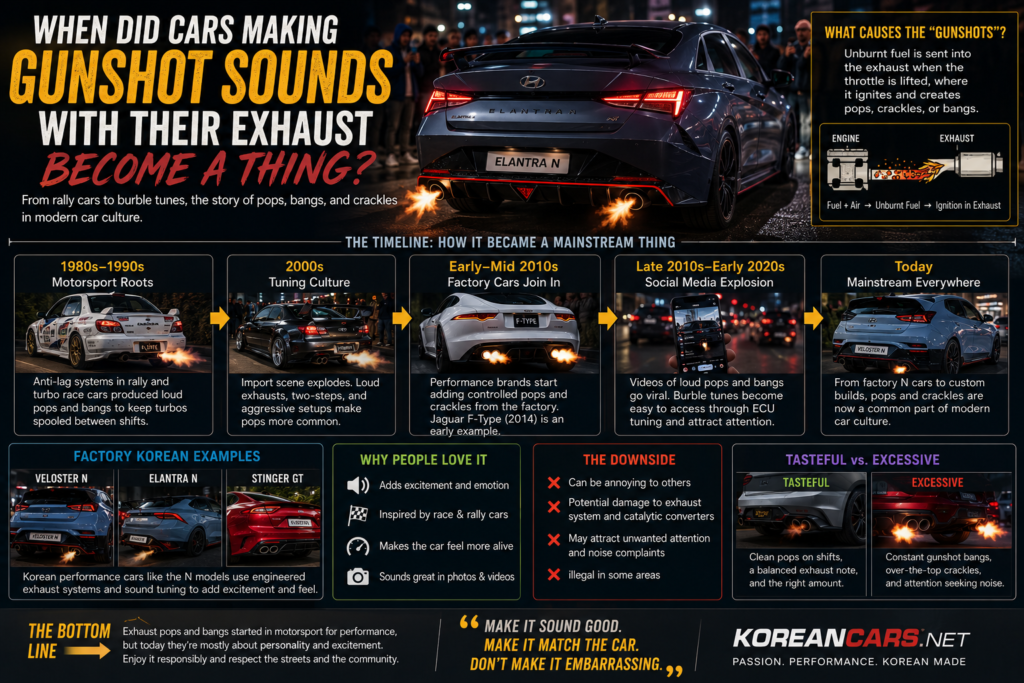
If you have been around car meets, downtown streets, parking garages, or late-night cruise spots over the last decade, you have probably heard it.
A car drives by, lifts off the throttle, and suddenly the exhaust starts going:
Pop. Pop. Bang. Crackle. BOOM.
To some enthusiasts, it sounds aggressive and exciting. To others, it sounds obnoxious, fake, or like someone set off fireworks in traffic.
But when did this become a thing?
The short answer is this: exhaust pops and bangs have existed for as long as combustion engines have been pushed hard, but the modern trend of intentionally tuning street cars to make loud “gunshot” exhaust sounds became popular mainly in the 2010s.
The longer answer involves race cars, rally anti-lag, turbocharging, factory performance cars, ECU tuning, YouTube culture, and the rise of modern enthusiast brands like Hyundai N.
First: What Are These Sounds?
The sounds people describe as “gunshots” are usually called:
- Exhaust pops
- Crackles
- Burbles
- Overrun pops
- Pops and bangs
- Afterfire
- Burble tune
- Crackle tune
They usually happen when fuel ignites in the exhaust system instead of burning completely inside the engine’s combustion chamber.
That does not always mean something is broken. In some older cars, small burbles and pops could happen naturally because of carburetors, aggressive cams, rich fueling, exhaust leaks, or race tuning.
In modern cars, however, many pops are deliberately created or amplified through engine management and exhaust design.
The Original Source: Racing and Rally Cars
The real performance origin of loud exhaust bangs comes from motorsport.
Turbocharged race cars, especially rally cars, used systems designed to keep the turbocharger spinning when the driver lifted off the throttle. This is known as anti-lag.
MotorTrend describes anti-lag as a method of reducing the delay between opening the throttle and the turbocharger delivering useful torque. It became especially important in racing series where turbo restrictors increased lag. (MotorTrend)
Anti-lag systems can create violent popping, banging, and flames because combustion can continue in or near the exhaust manifold. In racing, this was not just for sound. It had a purpose: keeping boost ready between corners.
That is why old rally footage sounds so dramatic. The car is not just making noise for attention. It is using a brutal performance system that helps keep the turbo alive and responsive.
The Difference Between Real Anti-Lag and Street Pops
This is where a lot of people get confused.
A true rally-style anti-lag system exists for performance. It is hard on parts, creates extreme heat, and is usually not appropriate for normal street use.
A street-car burble tune is different.
A burble tune is usually designed mainly for sound. The Drive describes a burble tune as engine software that intentionally causes backfires and crackles for audible effect. (The Drive)
That distinction matters.
Real anti-lag: performance function.
Street burble tune: mostly sound and personality.
Some modern performance cars use controlled factory tuning to create mild crackles, but that is still not the same as an aggressive motorsport anti-lag system.
When Did It Become Popular on Street Cars?
Before the 2000s: Natural Pops and Race-Car Noise
Before ECU burble tunes became common, exhaust pops were usually a byproduct of the car’s setup.
You might hear pops from:
- Carbureted cars
- Modified muscle cars
- Rotary engines
- Rally cars
- Race cars
- Straight-piped setups
- Cars with aggressive cams
- Cars running rich
But it was not usually the main goal for the average street build. People wanted more power, better throttle response, or a better exhaust note. The pops were often just part of the character.
2000s: Tuning Culture Gets Louder
The 2000s were a major period for exhaust culture.
This was the era of:
- Fast & Furious influence
- Import tuning
- Turbo Hondas
- Subaru WRXs
- Mitsubishi Evos
- Nissan 240SX builds
- Rotary RX-7 culture
- Loud cat-backs
- Blow-off valves
- Two-step launch control
Cars were becoming more theatrical. Exhaust sound became part of a car’s identity.
Still, the average modified car was usually loud because of the exhaust system itself, not because someone specifically asked their tuner for a “gunshot map.”
Early 2010s: Factory Cars Start Making It Cool
The early 2010s were when the sound started becoming more mainstream.
Performance brands began realizing that sound mattered emotionally. Modern cars were becoming quieter, more turbocharged, more insulated, and more electronically controlled. Manufacturers had to engineer excitement back into the experience.
One important car often associated with the factory-pop era is the Jaguar F-Type. The Drive notes that the original 2014 Jaguar F-Type is one of the first factory cars the author remembers having a burble tune. (The Drive)
After that, more performance cars began leaning into the drama.
European performance cars, hot hatches, turbocharged sports cars, and factory sport compacts increasingly used exhaust valves, ECU tuning, and drive modes to create more emotional sound.
This is when pops and crackles started moving from “race-car side effect” to “factory performance feature.”
The Hyundai N Effect
For Korean car enthusiasts, Hyundai N played a major role in normalizing factory exhaust drama.
The Veloster N, i30 N, and Elantra N made pops and crackles part of the car’s personality. Hyundai’s own Veloster N material describes “Pops and Crackles” as a sporty exhaust sound similar to racing-car backfire, generated by retarding ignition timing during throttle lift-off and coordinated with the variable exhaust system. (Hyundai)
That is important because Hyundai did not hide it. They marketed it as part of the fun.
The Elantra N also uses a linear variable exhaust valve system, allowing the exhaust character to change depending on mode. Hyundai says the valve can vary from 0 to 100, with the exhaust more open in N mode. (Hyundai News)
This helped change the image of Korean performance cars. A Hyundai was no longer just a quiet economy car. Now you had factory Korean performance cars that cracked, popped, rev-matched, and sounded alive at a meet.
For younger KDM enthusiasts, this mattered.
The sound became part of the identity.
Why Did the Trend Explode?
1. Turbo Cars Became Common
Modern turbocharged engines respond well to ECU tuning. As more cars became turbocharged, it became easier for tuners to modify throttle, ignition, fueling, and exhaust behavior.
This made crackle tunes easier to create.
2. ECU Tuning Became More Accessible
In older decades, tuning was more mechanical. Today, much of a car’s personality is controlled by software.
That means tuners can change:
- Throttle response
- Fuel cut behavior
- Ignition timing
- Rev limits
- Launch control
- Exhaust valve behavior
- Sport mode mapping
As software tuning became more common, burble and crackle tunes became another menu item.
3. Social Media Rewarded Loud Cars
A subtle exhaust note may sound great in person, but a loud bang gets attention instantly on video.
Instagram, TikTok, YouTube Shorts, and car-spotting videos rewarded short, dramatic moments. A car that makes a huge bang under an overpass is more likely to be recorded, shared, and remembered.
That pushed the trend further.
The louder the clip, the more attention it got.
4. Factory Cars Made It Acceptable
Once manufacturers started selling cars with controlled pops and crackles, the sound became more socially accepted among enthusiasts.
If a factory Veloster N, Elantra N, F-Type, Abarth, AMG, BMW M car, or hot hatch could crackle from the factory, then aftermarket tuners had permission to go further.
Sometimes too far.
Why Do Some People Hate It?
The problem is not the small burble or clean overrun crackle.
Most enthusiasts enjoy a tasteful exhaust note.
The issue is the extreme version: repeated, artificial, gunshot-like bangs in residential areas, tunnels, plazas, or downtown streets.
At that point, it stops sounding like performance and starts sounding like noise pollution.
Cities have also become more aggressive about vehicle noise enforcement. In Toronto, the city’s noise rules specifically address motor vehicle and motorcycle noise, including persistent revving from stationary vehicles and decibel limits for certain situations. (City of Toronto)
Ontario has also targeted muffler modifications that increase sound output, with legislation aimed at excessive or unusual noise. (Legislative Assembly of Ontario)
So the trend is not just a car-culture debate. It is also becoming a legal and community issue.
Is It Bad for the Car?
It depends on how aggressive the setup is.
A mild factory system is engineered with temperature limits, emissions systems, warranty concerns, and durability testing in mind.
An extreme aftermarket crackle tune can be much harder on components.
Potential risks include:
- Higher exhaust temperatures
- Catalytic converter damage
- Muffler damage
- Turbo stress
- Exhaust valve wear
- Increased fuel smell
- Check engine lights
- Failed emissions testing
- Unwanted attention from police
A factory Hyundai N system is not the same thing as a random aggressive burble tune on a high-mileage turbo car.
One is engineered as part of the car. The other may be added mostly for noise.
Tasteful vs. Obnoxious
There is a big difference between:
A clean pop on an upshift.
A few crackles on deceleration.
A deep burble from a well-built exhaust.
And:
Machine-gun bangs in traffic.
Explosions beside pedestrians.
Revving at 2 a.m. in a condo district.
A tune that sounds broken at every throttle lift.
Tasteful exhaust character adds personality. Excessive gunshot bangs can make the whole car scene look bad.
For KDM owners trying to earn respect at meets, this matters. A clean Genesis Coupe, Veloster N, Elantra N, Tiburon, or Stinger with a well-balanced exhaust will usually get more respect than a car that sounds like it is trying too hard.
How This Applies to Korean Cars
Hyundai Tiburon
Most Tiburons do not naturally make modern-style crackle sounds unless heavily modified. A clean exhaust tone usually suits the car better than forced gunshot bangs.
The Tiburon has a classic early-2000s coupe personality. It benefits more from a smooth, sporty exhaust note than excessive popping.
Genesis Coupe
The Genesis Coupe is one of the more common KDM platforms for louder exhaust setups.
The 2.0T can be tuned for turbo-car drama, while the 3.8 V6 can sound strong with the right exhaust. But bad exhaust choices can also make the car raspy or harsh.
A good Genesis Coupe exhaust should sound aggressive without becoming messy.
Veloster N
The Veloster N is one of the most important Korean cars in this conversation because pops and crackles are part of its factory personality.
It showed that Hyundai could build a car that felt playful, emotional, and slightly wild right from the showroom.
Elantra N
The Elantra N carries the same idea forward in a more mature package.
Its exhaust character is part of what makes it feel special compared with regular sport compacts. It gives the car emotion, not just numbers.
Kia Stinger GT
The Stinger GT is different. It is more of a grand tourer, so it usually works best with a deeper, refined exhaust tone rather than excessive crackles.
A Stinger should sound powerful, not cheap.
So When Did Gunshot Exhaust Sounds Become a Thing?
Here is the realistic timeline:
Motorsport origins: 1980s–1990s
Anti-lag and race-car exhaust bangs became famous through turbo racing and rally culture.
Street tuning influence: 2000s
Import tuning, turbo builds, two-step launch control, and loud exhausts made dramatic sounds more common.
Factory performance era: early-to-mid 2010s
Cars like the Jaguar F-Type helped make factory pops and crackles part of the performance-car experience.
Social media explosion: late 2010s–early 2020s
Burble tunes became common because they were easy to capture on video and got attention quickly.
Modern era: today
The sound is now everywhere—from factory Hyundai N cars to aggressively tuned BMWs, GTIs, WRXs, Genesis Coupes, and street builds.
Final Thoughts
Cars making gunshot-like exhaust sounds did not come out of nowhere.
The roots come from real motorsport: anti-lag, rally cars, turbo systems, and hard-driven engines. But the modern street trend is mostly a product of ECU tuning, factory performance theatrics, and social media attention.
A little crackle can make a car feel alive. It can add emotion, drama, and personality. Hyundai N proved that even modern Korean performance cars can use exhaust sound as part of the driving experience.
But when it becomes excessive, it can cross the line from performance character into attention-seeking noise.
The best exhaust setups still follow the old rule:
Make it sound good.
Make it match the car.
Do not make it embarrassing.
For Korean car enthusiasts, the goal should not be to make the loudest car at the meet. The goal should be to build a car that sounds intentional, balanced, and worthy of respect.