0
 0
You’ve probably felt it at some point.
You show up with your car—maybe it’s:
- A stock build
- A beginner project
- Or even a clean KDM setup
And instead of:
- Curiosity
- Respect
- Conversation
You get:
- Dismissive looks
- Subtle comments
- Or straight-up gatekeeping
👉 So why does this happen?
Because gatekeeping in car culture isn’t random.
It comes from a mix of psychology, insecurity, identity, and history.
Let’s break it down honestly.
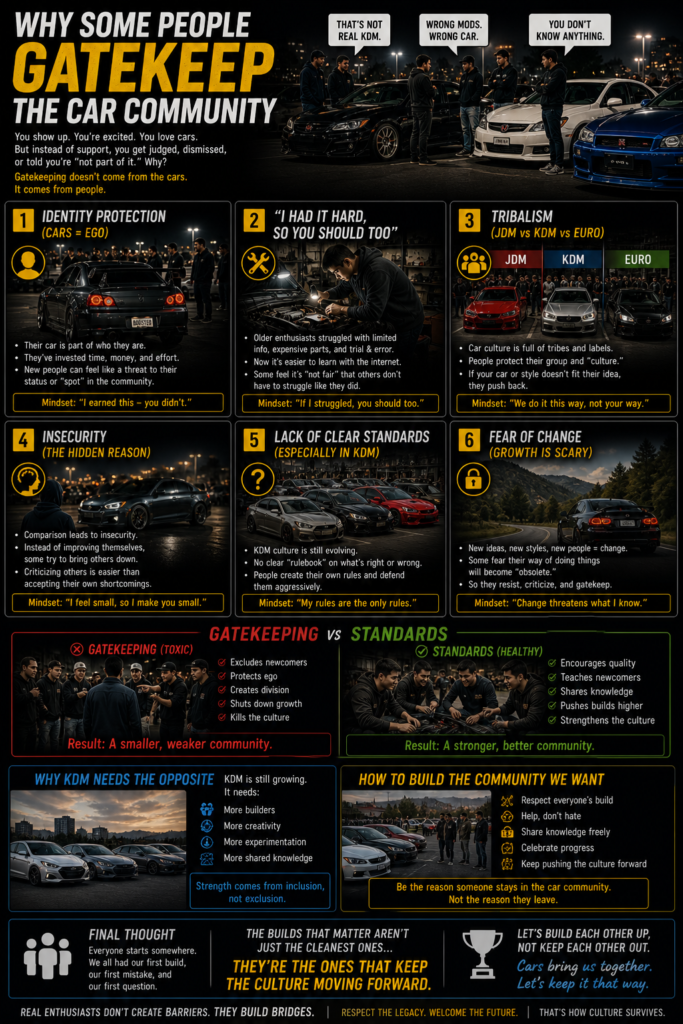
🧠 1. Identity Protection (Cars = Ego)
For many people, their car isn’t just a vehicle.
👉 It’s part of their identity.
They’ve:
- Spent years building it
- Learned skills over time
- Invested money and effort
So when new people enter the scene:
👉 It can feel like their “status” is being diluted
Gatekeeping becomes a way to say:
👉 “I earned this—you didn’t.”
⏳ 2. “I Had It Hard, So You Should Too”
Older enthusiasts often came up in a time where:
- Information was scarce
- Parts were hard to find
- Mistakes were costly
Now:
- YouTube tutorials exist
- Communities are bigger
- Parts are easier to access
👉 That creates resentment for some people
Mindset becomes:
👉 “If I struggled, you should struggle too.”
🧩 3. Tribalism (JDM vs KDM vs Euro)
Car culture is full of tribes:
- JDM
- Euro
- Muscle
- KDM
Each group develops:
- Pride
- Identity
- Standards
👉 Gatekeeping happens when people try to protect their “tribe”
Example:
- “That’s not real KDM”
- “That’s not how we do it”
📉 4. Insecurity (The Hidden Reason)
This is the one people don’t talk about.
Sometimes gatekeeping is just:
👉 Insecurity
- Someone sees a better build
- Someone newer progressing faster
- Someone doing things differently
Instead of:
- Learning
- Respecting
They:
- Criticize
- Dismiss
- Gatekeep
👉 It’s a defense mechanism
🧱 5. Lack of Clear Standards (Especially in KDM)
In some scenes (like JDM), standards are more defined.
KDM is still evolving.
👉 That creates confusion:
- What is “clean”?
- What is “correct”?
- What is “too much”?
So people:
- Create their own rules
- Defend them aggressively
⚠️ When Gatekeeping Becomes Toxic
Some level of standards is actually good.
👉 It helps maintain quality
But it becomes toxic when:
- Newcomers are discouraged
- People are mocked instead of guided
- Growth is blocked
👉 That kills the culture long-term
🔥 The Difference: Gatekeeping vs Standards
There’s an important distinction:
Healthy Standards:
- Encourage quality
- Teach newcomers
- Push builds higher
Gatekeeping:
- Excludes people
- Protects ego
- Shuts down growth
👉 One builds the community
👉 The other shrinks it
🌱 Why KDM Needs the Opposite
KDM is still growing.
It needs:
- More builders
- More experimentation
- More shared knowledge
👉 Not barriers
Because the strength of KDM is:
👉 It’s still being defined
🔮 Final Thought
Gatekeeping isn’t really about cars.
It’s about:
- Identity
- Ego
- Fear of losing status
But the strongest car communities aren’t the most exclusive.
They’re the ones that:
👉 Bring people in and level them up
Because at the end of the day:
👉 Everyone starts somewhere
And the builds that matter most aren’t just the cleanest ones…
They’re the ones that keep the culture moving forward.