0
0
 0
0
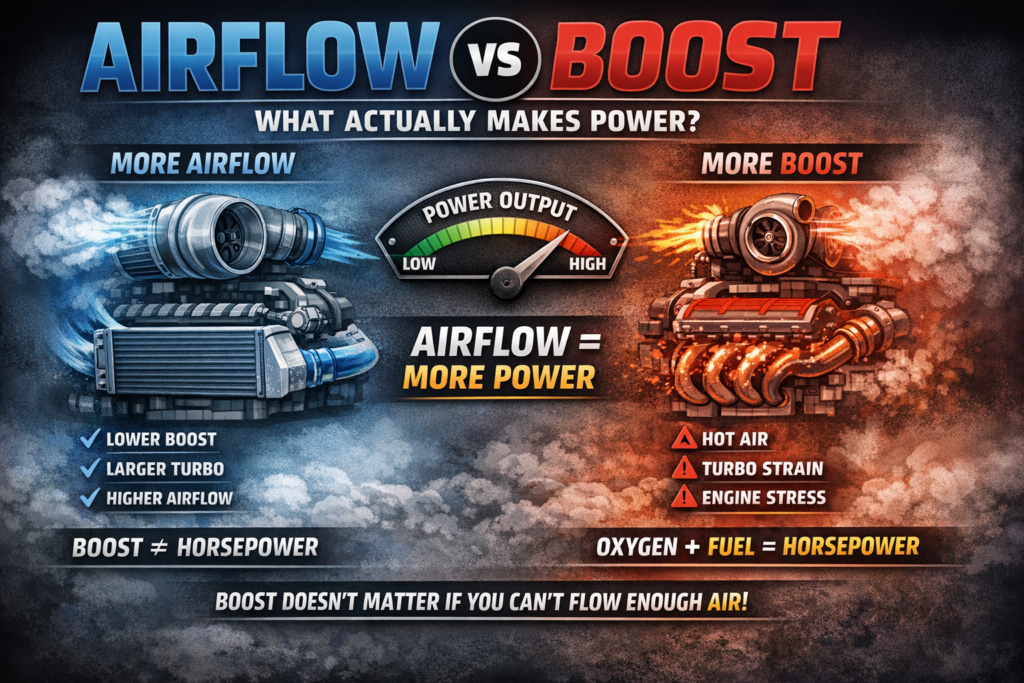
Why chasing PSI numbers might be the biggest mistake in your build
Editor’s Note
Ask almost anyone new to turbo cars how to make more power and you’ll hear the same answer:
“Turn up the boost.”
It sounds logical.
More boost = more power… right?
Not exactly.
Because in reality, boost is not what makes power.
Airflow is.
And understanding the difference is what separates a clean, efficient build from one that feels fast on paper—but underdelivers (or worse, breaks).
🧠 The Biggest Misconception in Turbo Tuning
Boost (PSI) is often treated like a power number.
It’s not.
Boost is simply:
👉 pressure inside your intake system
It tells you how hard the engine is working to push air in.
But it doesn’t tell you:
- how much air is actually entering
- how efficiently the system is flowing
- how much power you’re making
🌬 What Actually Makes Power: Airflow
Power comes from one thing:
👉 how much oxygen your engine can burn
More oxygen → more fuel → more combustion → more power
This is measured as:
- airflow (CFM)
- or mass air (grams/sec)
⚖️ Boost vs Airflow (Simple Comparison)
Let’s break it down.
Scenario A:
- Small turbo
- High boost (20 PSI)
- Restricted airflow
Scenario B:
- Larger turbo
- Lower boost (12 PSI)
- High airflow
👉 Scenario B can make MORE power.
Why?
Because it’s moving more air—not just compressing it harder.
🔧 Real-World Example (Hyundai Builds)
Take a Hyundai Genesis Coupe or Hyundai Elantra N.
You could:
Option 1:
- crank stock turbo to high boost
- hit heat limits
- lose efficiency
Option 2:
- upgrade turbo
- run lower boost
- move more air
Option 2 will:
- make more power
- run cooler
- be more reliable
🔥 Why High Boost Can Actually Hurt Performance
More boost sounds exciting—but it comes with problems.
❌ Heat
Compressing air increases temperature.
Hot air = less dense = less oxygen.
❌ Turbo inefficiency
Small turbos pushed too hard:
- generate excessive heat
- lose efficiency
- choke airflow
❌ Engine stress
Higher boost increases:
- cylinder pressure
- knock risk
- wear and tear
👉 So more boost can actually mean:
less efficient power + more risk
🧪 The Sweet Spot: Efficient Airflow
The goal isn’t “max boost.”
The goal is:
👉 maximum airflow at optimal efficiency
That means:
- proper turbo sizing
- efficient intercooling
- smooth airflow path
⚙️ What Actually Improves Airflow
If you want real power gains, focus on:
1. Turbo size & design
A properly sized turbo moves more air efficiently.
2. Intercooler
Cooler air = denser air = more power.
3. Intake system
Less restriction = better airflow.
4. Exhaust flow
Backpressure kills performance.
5. Piping design
Smooth airflow > tight bends and restrictions.
📊 Why Dyno Numbers Can Be Misleading
Two cars can both run:
👉 18 PSI
But:
- one makes 280HP
- the other makes 350HP
The difference?
👉 airflow efficiency
🧠 The Mindset Shift
Beginner mindset:
“How much boost are you running?”
Advanced mindset:
“How much air are you moving?”
🚀 The Korean Car Advantage
Platforms like:
- Hyundai Genesis Coupe
- Hyundai Elantra N
…are perfect for learning this concept.
Why?
Because:
- they respond well to airflow upgrades
- they’re often over-boosted on stock setups
- they benefit massively from efficiency improvements
🏁 Final Thoughts
Boost is easy to chase.
Airflow is harder to understand.
But once you get it:
👉 everything about tuning starts to make sense
🔥 Closing Line
Boost tells you how hard your engine is working.
Airflow tells you how much power it’s actually making.