0
0
 0
0
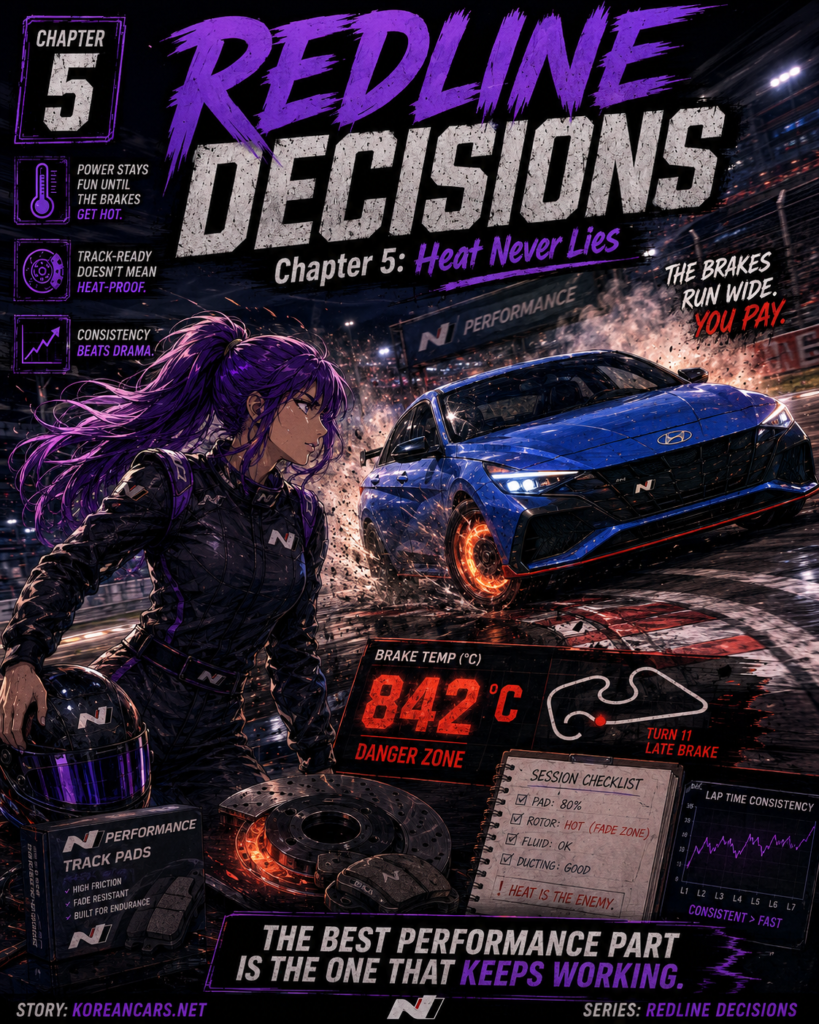
The lap timer showed the same number twice.
Then, on the next lap, it showed something better.
Erin Vale glanced at the display as her blue Hyundai Elantra N crossed the timing line.
Another personal best.
Not by much.
But it was real.
Her hands remained calm on the steering wheel as she approached the braking zone. The car no longer darted unpredictably into corners or demanded constant corrections. The revised alignment worked with her instead of challenging her.
Brake.
Release.
Turn.
Apex.
Throttle.
The sequence felt almost automatic.
For the first time since she began taking the car to the track, Erin was no longer chasing individual moments of speed.
She was building laps.
One after another.
Consistent.
Controlled.
Repeatable.
That confidence created a new temptation.
She wanted to stay out longer.
Back in the paddock, Erin parked beside a row of modified cars.
Drivers opened their hoods, checked tire pressures, and inspected their brakes. One man had his front wheels removed. Another was bleeding fluid from a caliper into a clear bottle.
Erin watched them for a moment.
Her friend Mina, who drove a modified Veloster N, crouched beside her own car with a flashlight.
“You’re checking the brakes again?” Erin asked.
Mina looked up.
“Pads, fluid, dust boots. The usual.”
“You checked them this morning.”
“And now I’ve done three sessions.”
Erin leaned against her Elantra.
“The brakes still feel fine.”
Mina smiled.
“That’s usually what people say before they stop feeling fine.”
Erin looked toward the track.
The next session was beginning to line up.
Her car was an N model. It had been designed for this kind of driving. The brakes were large, the chassis was capable, and the car had already survived multiple track days without drama.
She tightened her helmet strap.
“I’m going back out.”
Mina nodded toward the front wheels.
“Give it a cooldown lap before you come in.”
Erin raised a hand in acknowledgement.
“I know.”
She did know.
She simply did not always do it.
The morning air had been cool.
By early afternoon, the heat sat heavily over the circuit.
Sunlight shimmered above the asphalt. Tire rubber gathered along the edges of the racing line. The inside of Erin’s helmet felt warmer with every lap.
She followed a black coupe through the first sector.
The driver was quick but inconsistent.
Erin remained patient.
She stayed close through the corners, carried better speed onto the straight, and finally passed when the track opened ahead.
A grin appeared beneath her visor.
The car felt perfect.
The tires were working.
The alignment was working.
The additional power no longer overwhelmed her.
She pressed harder.
One fast lap became two.
Two became four.
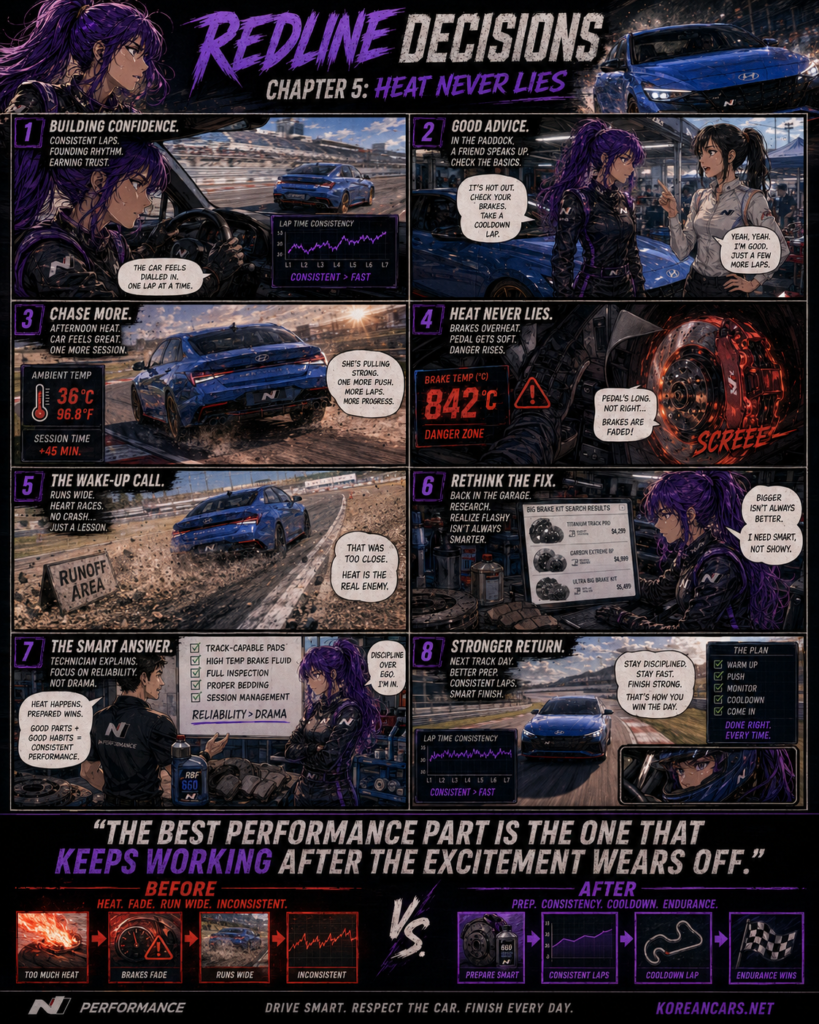
On the fifth lap, the brake pedal travelled slightly farther than before.
Erin noticed it.
But the car still slowed.
She continued.
At the end of the back straight, she braked from high speed.
The pedal felt softer.
Not absent.
Not useless.
Just different.
She pressed harder and turned into the corner.
The car made the apex, though later than she intended.
Her pulse quickened.
“That was me,” she said inside the helmet.
She had braked too late.
That was all.
The next lap, she approached the same braking zone with greater caution.
Her foot pressed the pedal.
For a fraction of a second, the response did not match the pressure.
The pedal moved deeper.
The corner rushed toward her.
Erin pressed harder.
The brakes caught, but the car was carrying too much speed.
She released the steering slightly and drove straight into the paved runoff area.
No spin.
No impact.
Just the sound of rubber, rapid breathing, and the engine falling back toward idle.
Erin stopped beyond the corner.
Her hands tightened around the wheel.
The marshal waved a yellow flag, then pointed her toward the re-entry lane.
She nodded.
Slowly, she returned to the circuit.
The brake pedal still worked.
But the confidence was gone.
She completed a cautious lap and entered the pits.
Mina was waiting when Erin returned.
She did not ask whether the lap had been fast.
She looked at Erin’s face.
“What happened?”
“The pedal went soft.”
“How many laps?”
“Six. Maybe seven.”
“Hard laps?”
Erin removed her helmet.
“Yes.”
“Any cooldown?”
Erin did not answer.
Mina nodded.
“Let it cool before you touch anything.”
Erin stepped out of the car.
The front wheels radiated heat. A faint smell hung around them—sharp, metallic and unfamiliar.
She crouched near the driver-side wheel but did not touch it.
The car looked normal.
That disturbed her more than visible damage would have.
Nothing appeared broken.
Yet, a few minutes earlier, the brake pedal had stopped feeling trustworthy.
Mina knelt beside her.
“Speed creates heat,” she said. “Heat keeps accumulating until something gives you a warning.”
Erin stared through the wheel at the caliper.
“I thought the factory brakes were track-ready.”
“They are capable.”
“That sounds like another ‘but.’”
“It is.”
Mina pointed toward the car.
“Track-ready doesn’t mean immune to heat. Pads wear. Fluid absorbs moisture. Tires overheat. Drivers stay out too long.”
Erin looked down.
“So the brakes failed?”
“No. They communicated.”
“By almost sending me off the track?”
“Apparently, subtle communication wasn’t working.”
That evening, Erin sat in her garage with the front wheels removed.
The car rested on stands beneath bright overhead lights.
Her purple hair was tied back, and dark brake dust marked the fingertips of her gloves.
The pads still had material remaining.
But the surfaces looked different from the new examples she found online. The edges were worn, and the faces carried a smooth, hardened appearance.
Glazed.
The fluid reservoir looked ordinary.
Everything looked ordinary.
That was the problem with heat.
It left consequences that were not always dramatic enough to photograph.
Erin opened her laptop.
A familiar search began.
Elantra N big brake kit
The results were immediately impressive.
Large calipers.
Two-piece rotors.
Bright colours.
Aggressive designs visible through the wheels.
Prices rose into the thousands.
Her old instincts returned.
The most expensive option looked like the safest option.
The largest kit looked like the most serious solution.
She opened six tabs.
Then eight.
Then twelve.
A complete braking system appeared in her shopping cart.
She stared at the total.
It cost more than her tires, intake, tune and alignments combined.
Her finger hovered over the purchase button.
Then she stopped.
Chapter by chapter, the car had taught her the same lesson in different forms.
A dramatic solution was not automatically the correct one.
She closed the cart.
One tab at a time.
The next morning, Erin visited a performance shop specializing in track preparation.
A technician named Luis examined the pads and asked about the incident.
“How old is the brake fluid?”
Erin hesitated.
“I haven’t changed it since buying the car.”
“How long ago was that?”
“Two years.”
Luis nodded.
“What pads?”
“Factory.”
“How long are your sessions?”
“They’re supposed to be twenty minutes.”
“Supposed to be?”
“I stayed out longer.”
He placed the pads on the counter.
“You don’t necessarily need a big brake kit.”
Erin looked toward a display containing enormous six-piston calipers.
“You sell big brake kits.”
“I also sell what people need.”
He pointed toward her pads.
“You need a track-capable pad, fresh high-temperature fluid, proper inspection and better session management.”
“That’s all?”
Luis smiled.
“That sounds disappointing.”
“It sounds less exciting.”
“Good brakes are usually boring.”
He leaned against the counter.
“They should feel the same on the first braking zone and the last one. The moment they become exciting, something has probably gone wrong.”
Erin picked up one of the old pads.
“So the larger kit wouldn’t help?”
“It could increase heat capacity. It could also add cost, change pedal characteristics, complicate wheel fitment and create other compromises.”
He shrugged.
“You may eventually need one. But first, learn whether you are exceeding the existing system or simply misusing it.”
Again, Erin found herself hearing a familiar idea.
Do not copy the solution.
Understand the behaviour.
The preparation took most of the afternoon.
Fresh brake fluid.
Track-oriented pads.
Cleaned components.
Torque checked.
Luis showed Erin how to inspect pad thickness through the wheel and how to recognize changes in pedal feel before they became severe.
He also explained bedding procedures.
“You’re transferring a controlled layer of pad material onto the rotor,” he said. “Do it properly, and the brakes behave consistently. Do it badly, and you can create vibration or uneven deposits.”
Erin listened carefully.
This modification did not have a dramatic sound.
It did not increase horsepower.
It did not change the car’s stance.
Nobody walking past the Elantra would notice it.
Yet it might be the most important preparation she had made.
At the next track day, Erin approached the circuit differently.
She arrived earlier.
She checked the fluid level.
She measured the pads.
She torqued the wheels.
She marked the tire sidewalls and wrote the morning pressures in a notebook.
Before the first session, Mina walked over.
“Big brake kit?”
Erin shook her head.
“Pads and fluid.”
Mina smiled.
“Less glamorous.”
“Hopefully more useful.”
“That’s usually how it works.”
The first session began slowly.
Erin allowed the tires and brakes to reach operating temperature. She avoided chasing lap times immediately.
On the third lap, she increased the pace.
The pedal felt firm.
The braking response was clear.
She completed another lap.
Then another.
The pedal remained the same.
That consistency gave her more confidence than any increase in engine power had.
She could brake at the same marker.
Release pressure at the same rate.
Turn with the same balance.
There was no uncertainty beneath her foot.
Near the end of the session, the lap timer showed a time close to her personal best.
Erin could have continued.
The track ahead was clear.
The car felt strong.
Her instincts told her to take one more fast lap.
Instead, she lifted.
She allowed the car to flow around the circuit at reduced speed. Air moved through the brakes. Temperatures began to fall.
The cooldown lap felt painfully slow.
It also felt responsible.
When she returned to the paddock, the pedal remained firm.
Mina looked at the timer.
“You had another lap in it.”
“I know.”
“You came in anyway?”
Erin removed her helmet.
“I want the car ready for the next session.”
Mina nodded.
“Now you’re thinking like a track driver.”
During the afternoon, other cars began to struggle.
One driver complained of vibration.
Another ended his day with almost no pad material remaining.
A heavily modified coupe completed three impressive laps and then spent the rest of the session in the paddock with its hood open.
Erin’s Elantra kept circulating.
Her individual fastest lap improved only slightly.
But across the entire day, she completed more consistent laps than ever before.
No frightening pedal movement.
No desperate corrections.
No wasted sessions.
Late in the afternoon, she sat on the pit wall and reviewed her times.
Her first fast lap and final fast lap were separated by less than a second.
The car had not merely become faster.
It had become dependable.
She looked toward the Elantra.
Brake dust covered the wheels. Small stones clung to the warm tires. The paint carried a thin layer of track grime.
It did not look perfect.
It looked used properly.
On the drive home, Erin stopped at a red light.
The street was quiet.
She pressed the brake pedal.
Firm.
Predictable.
Ordinary.
She smiled.
For years, she had associated performance with things that demanded attention.
Louder sounds.
Sharper steering.
Harder acceleration.
More dramatic numbers.
But the brake upgrade had taught her something different.
The best-performing systems were often the ones she stopped noticing.
They worked repeatedly.
They remained consistent.
They let her focus on driving.
The light turned green.
Erin released the pedal and continued through the city.
The car had not gained horsepower.
It had gained endurance.
And so had she.
Final Line
“The best performance part may be the one that keeps working after the excitement wears off.”
End of Chapter 5