0
0
 0
0

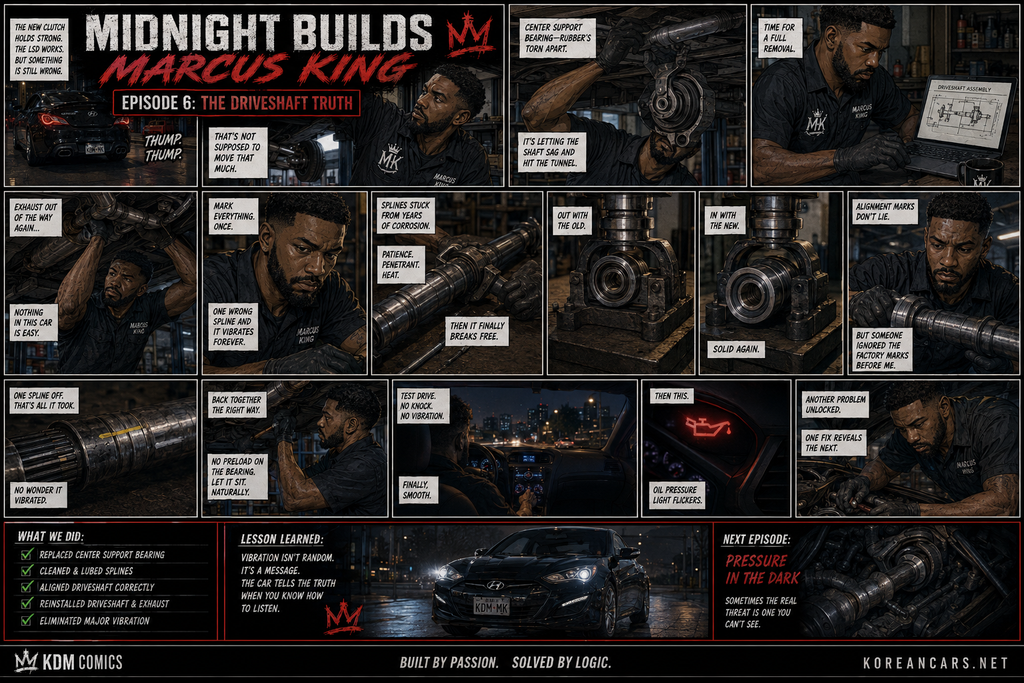
The clutch slipped again before Markus reached the garage.
He was in fourth gear, barely above two thousand rpm, when he pressed the throttle and watched the tachometer surge forward without the Genesis matching it.
The engine sounded powerful.
The car felt weak.
Markus lifted his foot immediately.
A slipping clutch could sometimes survive gentle driving for weeks. Under boost, however, every flare of the engine polished more friction material from the disc and converted it into heat. The damage accelerated each time the clutch failed to hold.
Markus drove the final kilometres without entering boost.
The black Genesis Coupe rolled into the garage at 4:08 a.m.
He shut the engine off and remained behind the wheel.
The axle seal was dry. The differential worked. The suspension finally behaved. Every improvement had allowed the engine to deliver more torque to the drivetrain.
Now the clutch was being asked to hold power it had never been designed to carry.
Markus rested one hand on the shifter.
“You lasted longer than I expected.”
The clutch had not suddenly become weak.
The rest of the car had finally become strong enough to expose it.
By noon, the garage floor was covered with boxes.
A reinforced clutch disc.
A higher-capacity pressure plate.
A new release bearing.
A pilot bearing.
Fresh transmission fluid.
Replacement flywheel bolts.
Markus had ordered the parts months earlier, knowing this night would eventually arrive. He had avoided installing them because the factory clutch remained smooth, quiet and forgiving in traffic.
A performance clutch would hold more torque.
It could also produce heavier pedal effort, sharper engagement and more drivetrain noise. More strength almost always demanded something in return.
Markus opened the clutch box and studied the disc.
Its friction material was more aggressive than the original organic lining. The hub used heavy springs to absorb some of the shock created when the clutch engaged. The pressure plate beside it carried a stronger diaphragm spring designed to clamp the disc against the flywheel with greater force.
The parts looked simple.
Their job was not.
The clutch had to connect a violently rotating engine to a stationary transmission without breaking either one. It needed to slip smoothly during takeoff, lock completely under power and release instantly whenever Markus pressed the pedal.
Too little holding force, and the engine would overwhelm it.
Too much shock, and the transmission, differential or axles could become the next sacrifice.
Markus looked toward the Genesis.
“Everything passes the damage forward.”
He raised the car.
Removing the transmission was never technically complicated.
It was physically unforgiving.
Markus disconnected the battery, removed the intake components blocking access and worked his way through the wiring, brackets and hydraulic lines surrounding the transmission.
He labeled every connector.
He placed bolts into separate trays based on their location.
Bellhousing.
Starter.
Crossmember.
Driveshaft.
Exhaust.
No pile of mystery hardware would be waiting for him during reassembly.
The exhaust fasteners fought first.
Years of heat cycles had transformed the nuts into rusted extensions of the studs. Markus soaked them with penetrating fluid, heated the stubborn connections and worked them backward a fraction at a time.
One nut released.
The second rounded.
Markus stared at it.
It was already afternoon, and the transmission had not moved.
He could force an extractor onto the damaged nut. He could cut it. He could remove more of the exhaust and attack it from another angle.
The old version of Markus would have chosen the loudest solution.
Instead, he cleaned the nut, hammered on a slightly smaller socket and applied steady pressure.
The fastener released with a sharp crack.
Markus exhaled.
“Leverage. Alignment. Understanding.”
The same lesson twice in two days.
He supported the transmission with a jack, removed the crossmember and disconnected the driveshaft. The Genesis now hung above him with its drivetrain partially suspended and its underside exposed.
The transmission bolts came free one by one.
Only the bellhousing remained.
Markus lowered the transmission slightly and pulled it rearward.
Nothing moved.
He checked every connection again.
All bolts removed.
Hydraulic line disconnected.
Wiring clear.
Starter out.
Still, the transmission remained attached to the engine.
Markus rocked it gently.
The bellhousing shifted less than a millimetre and stopped.
The input shaft was trapped inside the clutch disc.
He adjusted the angle of the transmission jack and tried again.
The housing separated a little farther.
Then it jammed.
For the next forty minutes, Markus moved between the engine bay and the underside of the car, raising one end, lowering the other and rotating the transmission slightly each time.
The gap widened.
A dark line appeared between the bellhousing and the engine block.
Markus placed both hands against the casing.
“One more.”
He pulled.
The transmission slid backward.
Its input shaft cleared the clutch assembly, and the entire unit settled onto the jack.
For the first time, the clutch was visible.
The smell reached him immediately.
Burned friction material.
Markus removed the pressure plate bolts gradually, rotating around the assembly so the spring force released evenly.
The pressure plate separated from the flywheel.
The clutch disc dropped into his hand.
It was worse than he expected.
The friction material had worn nearly to the rivets. Several sections were glazed smooth and reflective from heat. Fine black dust covered the inside of the bellhousing.
The flywheel showed blue-purple heat marks.
Markus ran a finger across its surface.
Some discoloration could be removed by machining. Deep cracks or severe distortion would require replacement.
He placed a straightedge across the flywheel and checked for obvious warping. Then he rotated the engine and examined the full circumference.
No visible cracks.
But the surface was uneven enough that installing a fresh clutch against it would be a gamble.
A new clutch needed a clean, flat surface to bed into correctly. Bolting it against a damaged flywheel could create chatter, uneven engagement and early failure.
Markus took photographs and called the machine shop.
A familiar voice answered.
“King Performance.”
“It’s Markus.”
“What did you break?”
“The clutch surrendered.”
“That isn’t breaking. That’s upgrading.”
Markus looked at the burned disc.
“I need a flywheel resurfaced.”
“Bring it before five.”
Markus checked the clock.
4:21 p.m.
The machine shop was thirty-five minutes away.
He removed the flywheel bolts, lifted the heavy steel disc from the crankshaft and placed it in the passenger seat of his daily driver.
For the first time since sunrise, he left the garage.
The machinist placed the flywheel onto a metal table and examined the heat marks.
“Turbo car?”
Markus nodded.
“How much torque?”
“Enough.”
The machinist smiled.
“That’s what everyone says before buying a second transmission.”
He measured the flywheel and inspected the clutch surface.
“It can be saved. Barely.”
“How long?”
“Tomorrow afternoon.”
Markus looked through the shop window toward the parking lot. The sky had already begun to darken.
“I need it tonight.”
The machinist laughed.
Markus did not.
“You’re serious.”
“I have everything apart.”
“You and half the city.”
Markus placed the old clutch disc on the counter.
The machinist studied the glazed friction material.
“You drove this here?”
“No.”
“Good. Because that thing had maybe one hard pull left.”
He turned toward the resurfacing machine.
“Give me two hours.”
Markus returned to the garage and cleaned the bellhousing while he waited.
The release bearing felt rough when he spun it by hand. It had not failed yet, but it was close enough that replacing it was obvious.
The pilot bearing offered more resistance than it should.
Another small part nearing the end of its life.
Markus inspected the transmission input shaft for wear and examined the rear of the engine for signs of oil leakage. A leaking rear main seal could contaminate the new clutch and force the entire transmission to be removed again.
The area was dry.
He left the seal alone.
Replacing a healthy factory seal simply because access was convenient could create a new leak where none existed before.
By the time the machinist called, the bellhousing was clean, the clutch fork had been inspected and every reusable component was ready.
The resurfaced flywheel looked transformed.
The burned surface had been replaced by a clean, even finish designed to help the new clutch bed in.
The machinist handed it across the counter.
“Don’t glaze this one.”
Markus lifted the flywheel.
“Tell the turbo.”
Installation began shortly after midnight.
Markus cleaned the flywheel and pressure plate surfaces to remove any protective oil. He installed the flywheel using new bolts and tightened them gradually in the proper sequence.
The pilot bearing followed.
Then came the clutch disc.
One side faced the flywheel.
The other faced the transmission.
Installed backward, the disc hub could interfere with the flywheel bolts or prevent the clutch from releasing properly.
Markus checked the markings twice.
He inserted the alignment tool through the clutch disc and into the pilot bearing. The tool held the disc perfectly centred while the pressure plate was installed.
Without that alignment, the transmission input shaft would never slide through.
Markus lifted the pressure plate into position and threaded each bolt by hand. He tightened them gradually in a crossing pattern, watching the diaphragm spring compress evenly.
When the final bolt reached torque, the clutch sat centred against the flywheel.
Everything looked correct.
That was when Markus noticed the hydraulic line.
A damp section had formed near the clutch slave cylinder connection.
He wiped it.
Fluid returned.
Not enough to drip.
Enough to matter.
Markus closed his eyes.
The clutch system had already been opened during transmission removal. A disturbed fitting or aging seal could allow air into the hydraulic circuit, preventing the clutch from releasing fully.
The transmission was still out.
Access would never be easier.
He replaced the small sealing washers, inspected the line and tightened the connection correctly.
The dampness disappeared.
One more failure prevented before it became a roadside diagnosis.
Markus positioned the transmission jack beneath the Genesis.
Reinstallation should have been easier than removal.
It was not.
The transmission moved forward until the input shaft reached the clutch disc.
Then it stopped.
Markus adjusted the jack.
The transmission moved another centimetre.
Stopped again.
He rotated the output shaft slightly while applying gentle forward pressure.
No change.
The alignment tool had centred the clutch, but the angle between the engine and transmission remained imperfect.
Markus raised the rear of the transmission.
Too high.
Lowered it.
Too low.
Shifted it left.
Then right.
The bellhousing remained several centimetres from the engine block.
Sweat ran down Markus’s face.
The transmission weighed too much to fight and cost too much to force.
He refused to use the bellhousing bolts to pull it into place. Doing so could damage the threads, crack the housing or force the input shaft against the clutch disc.
The transmission had to slide home naturally.
Markus stepped away and drank water.
The garage was silent except for the ticking of cooling metal.
He stared at the angle of the engine.
The engine had tilted slightly after the transmission was removed.
He raised the front of the engine a few millimetres with a second jack.
Then he returned beneath the car, rotated the output shaft and pushed.
The transmission moved forward.
The input shaft entered the pilot bearing.
The bellhousing met the engine block with a solid metallic sound.
Markus smiled despite himself.
“Understanding.”
By 5:17 a.m., the Genesis was whole again.
Transmission installed.
Driveshaft connected.
Crossmember torqued.
Exhaust secured.
Hydraulic system bled.
Fresh fluid added.
Markus lowered the car and sat behind the wheel.
He pressed the clutch pedal.
It was heavier.
Not extreme, but deliberate.
The old clutch had moved with casual softness. This pressure plate pushed back.
Markus started the engine.
The Genesis came alive.
He selected first gear.
The shifter entered smoothly.
He released the clutch slowly.
The engagement point arrived sooner than before and much more sharply. The car moved forward with less pedal travel, forcing Markus to recalibrate years of muscle memory.
He stopped.
Tried again.
Smoother.
The new clutch was not difficult.
It simply refused to hide careless inputs.
Markus pulled onto the street.
The first drive remained gentle.
A new clutch required time for the friction surfaces to mate properly. Hard launches and full-boost pulls could create hot spots before the disc had bedded evenly against the flywheel and pressure plate.
Markus shifted early.
He avoided slipping the clutch unnecessarily.
At each intersection, he focused on clean engagement.
The clutch transmitted more vibration through the pedal. The drivetrain made slightly more noise at low engine speed. Nothing felt broken.
It felt honest.
The next several nights followed the same routine.
Drive.
Cool.
Inspect.
Repeat.
Markus used city traffic, back roads and long industrial routes to accumulate careful engagement cycles. He resisted the temptation to test full power.
Every empty road invited him.
Every turbo whistle challenged him.
He waited.
Power was easy to demand.
Patience was harder to build.
After the break-in distance had passed, Markus returned to the same industrial road where the old clutch had slipped.
The Genesis idled beneath the streetlights.
He selected third gear and allowed the engine speed to settle.
Then he pressed the throttle.
The turbocharger inhaled.
Boost climbed.
Torque reached the flywheel, passed through the reinforced clutch and entered the transmission.
The tachometer rose in direct proportion to the car’s acceleration.
No flare.
No hesitation.
The Genesis surged forward with a force Markus had never felt from it before. The differential transferred the power across both rear wheels, the suspension held the chassis stable and the clutch locked everything together.
For the first time, the entire drivetrain worked as one system.
Markus shifted.
The clutch engaged hard and clean.
The car lunged forward again.
He lifted before reaching excessive speed and allowed the Genesis to coast.
A quiet satisfaction settled over him.
The upgrade had worked.
Then a violent vibration travelled through the steering wheel.
Once.
Twice.
A heavy metallic knock came from beneath the car.
Markus released the throttle.
The vibration disappeared.
He applied light power again.
The knock returned.
Not from the engine.
Not from the transmission.
Farther back.
Markus slowed and listened.
The sound followed load rather than vehicle speed. It appeared when torque moved through the drivetrain and vanished when he coasted.
He pulled beneath a streetlight and stepped out.
The clutch held.
The differential held.
But something between them was moving when it should have remained fixed.
Markus crouched beside the Genesis and looked underneath.
One of the driveshaft support mounts sat at an angle.
Its rubber had torn almost completely away from the bracket.
The stronger clutch had not created the damage.
It had simply removed the softness that had hidden it.
Markus stared at the fractured support.
Every new part asked the old ones a question.
Eventually, one answered honestly.
He stood and looked down the empty road.
The Genesis was becoming stronger.
But strength was spreading through the car faster than its oldest components could survive.
To be continued…
Next Chapter: The Vibration Between Gears