
 0
0
 0
0
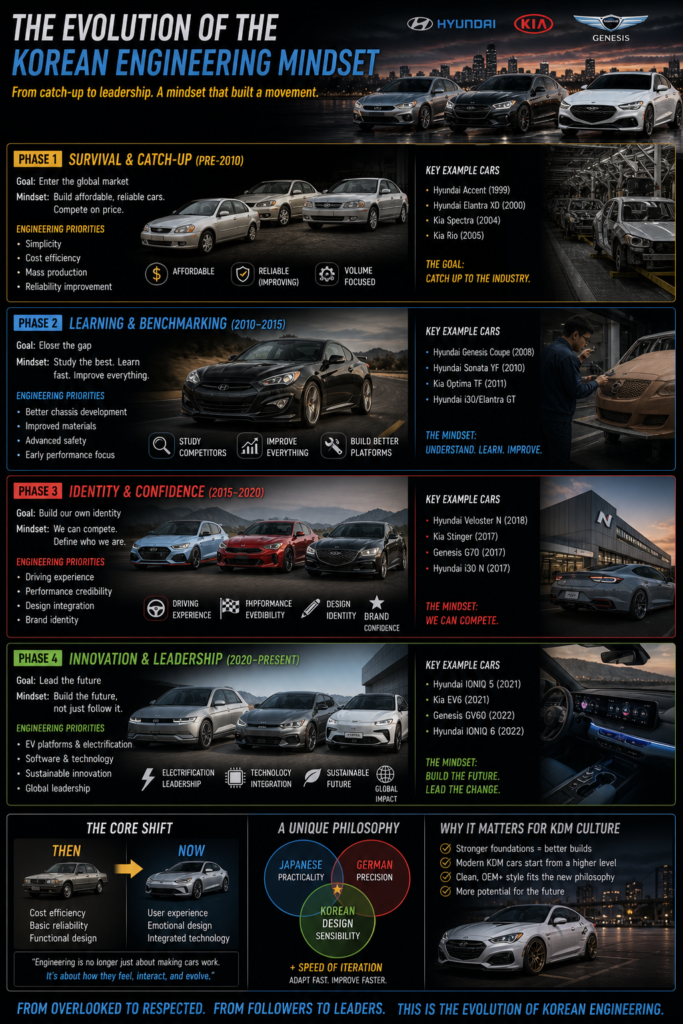
When people talk about Korean cars today, the conversation sounds very different than it did 20 years ago.
Back then:
- “Affordable”
- “Reliable (maybe)”
- “Not exciting”
Today:
- “Innovative”
- “Performance-focused”
- “Design-driven”
That shift didn’t happen by accident.
👉 It came from a fundamental evolution in engineering mindset—especially within companies like Hyundai Motor Company, Kia Corporation, and Genesis Motor.
Let’s break down how that mindset changed—and why it matters for car culture today.
🧱 Phase 1: Survival & Catch-Up (Pre-2010)


In the early years, Korean automakers were focused on:
👉 Survival and global entry
The mindset was:
- Build affordable cars
- Compete on price
- Improve reliability
Engineering priorities:
- Simplicity
- Cost efficiency
- Mass production
There was little emphasis on:
- Performance
- Driving feel
- Brand identity
👉 The goal wasn’t to lead—it was to catch up
🔧 Phase 2: Learning & Benchmarking (2010–2015)


This is where things started to shift.
Instead of just building cars:
👉 Korean engineers began studying competitors deeply
- German engineering (precision, performance)
- Japanese engineering (efficiency, reliability)
The mindset became:
👉 “Understand what works—and improve it”
Key changes:
- Better chassis development
- Improved materials
- Early performance platforms (Genesis Coupe)
👉 Still not leading—but now learning strategically
🚀 Phase 3: Identity & Confidence (2015–2020)


This is where the mindset truly evolved.
Instead of copying or following:
👉 Korean brands started defining their own identity
Examples:
- N performance division
- Kia Stinger
- Genesis luxury positioning
Engineering priorities shifted to:
- Driving experience
- Performance credibility
- Design integration
👉 The mindset became:
“We can compete”
🌐 Phase 4: Innovation & Leadership (2020–Present)


Now we’re seeing something new.
Korean automakers aren’t just competing—
👉 They’re leading in key areas
Especially in:
- EV platforms
- Interior technology
- Design language
The mindset today:
👉 “Build the future—not just follow it”
You see this in:
- Ioniq series
- EV6
- Genesis EV lineup
🧠 The Core Shift: From Efficiency → Experience
Here’s the real transformation:
Then:
- Cost efficiency
- Basic reliability
- Functional design
Now:
- User experience
- Emotional design
- Integrated technology
👉 Engineering is no longer just about making cars work
It’s about:
👉 How they feel, interact, and evolve
🔥 Why This Matters for KDM Culture
This mindset shift directly impacts modding culture.
Older Korean cars:
- Needed improvement
- Were blank canvases
Modern Korean cars:
- Start from a strong base
- Already have identity
- Reward subtle enhancement
👉 That’s why KDM builds today lean toward:
- OEM+
- Clean aesthetics
- Balanced performance
⚖️ A Unique Engineering Philosophy
Korean engineering today blends:
- Japanese practicality
- German precision
- Korean design sensibility
But adds something different:
👉 Speed of iteration
Korean companies:
- Adapt quickly
- Improve rapidly
- Take design risks
🔮 Final Thought
The evolution of Korean engineering isn’t just technical.
It’s philosophical.
From:
- “Make it cheap and reliable”
To:
- “Make it desirable and advanced”
And now:
- “Make it defining”
👉 That shift is why Korean cars have gone from overlooked…
To:
👉 one of the most interesting platforms in modern car culture


