0
0
 0
0
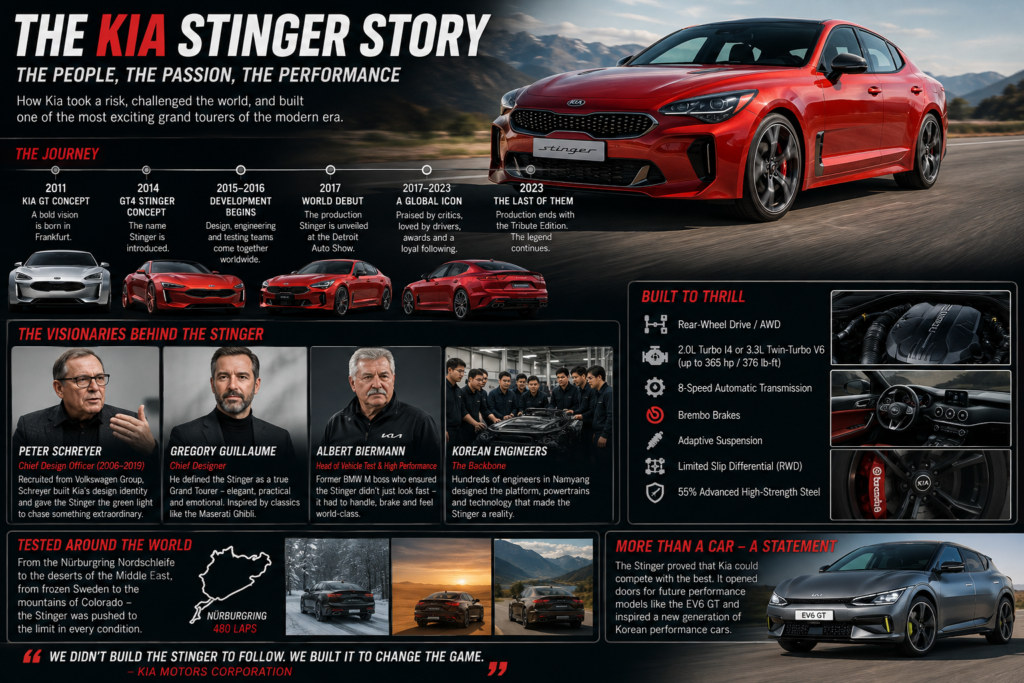
Excerpt: The Kia Stinger was not merely a fast sedan added to an existing product line. It was a deliberate attempt to change how the world viewed Kia. Its development brought together European designers, Korean engineers, former BMW M leadership and executives willing to approve a rear-wheel-drive grand tourer that made little conventional business sense—but enormous sense for the brand.
For much of its early history, Kia built its reputation around practical, affordable transportation. Its cars gradually became more reliable, refined and attractive, but the company was not commonly associated with rear-wheel drive, twin-turbocharged engines or Nürburgring chassis development.
The Kia Stinger was created to confront that perception directly.
It was a five-door fastback with a long hood, rear-drive proportions, available all-wheel drive, Brembo brakes and a 3.3-litre twin-turbocharged V6. More importantly, it was a declaration that Kia no longer wanted to be evaluated only according to price and practicality.
The Stinger’s creation required several different groups to align around an unusually ambitious idea. Peter Schreyer helped transform Kia’s design culture. Gregory Guillaume gave the car its grand-touring character. Albert Biermann made sure it drove with genuine credibility. Korean engineers, European aerodynamicists and global test teams then completed the less glamorous work required to turn a dramatic concept into a reliable production vehicle.
The Beginning: Kia’s 2011 GT Concept
The Stinger’s direct ancestor was the Kia GT Concept, unveiled at the 2011 Frankfurt Motor Show.
At the time, the idea of Kia producing a large, rear-wheel-drive performance fastback appeared improbable. Kia itself later acknowledged that many observers considered the GT Concept little more than a fantasy from a company still primarily associated with value-oriented mass-market vehicles. Internally, however, the concept generated enough enthusiasm to begin a development journey that would last approximately six years.
The GT Concept established the fundamental proportions that would define the production Stinger:
A long hood, a short front overhang, a low cabin positioned toward the rear, broad rear shoulders and a flowing fastback roofline.
These were not merely decorative choices. The proportions communicated that the engine was mounted longitudinally rather than transversely and that the vehicle had been conceived around rear-wheel drive.
Kia later adopted the Stinger name partly from the smaller GT4 Stinger concept shown at the 2014 North American International Auto Show. The production model’s basic form and philosophy, however, remained much closer to the 2011 GT Concept.
Peter Schreyer: The Man Who Gave Kia Permission to Be Bold
Any discussion of the Stinger must begin with Peter Schreyer, the German designer whose influence reached far beyond one vehicle.
Before joining Kia, Schreyer had spent more than 25 years within the Volkswagen Group and had been associated with vehicles including the original Audi TT, Audi A2, Volkswagen New Beetle and fourth-generation Volkswagen Golf. Kia recruited him in 2006 and gave him an unusually open assignment: establish a distinctive design identity for a company that had not yet developed one globally.
Schreyer’s most recognizable contribution was Kia’s “tiger nose” grille, but his greater achievement was cultural. He helped convince Kia that design did not need to be a decorative layer applied after the engineering was complete. Design could instead guide product planning, brand identity and even corporate ambition.
That cultural change was essential to the Stinger.
A conservative organization might have approved a mildly sportier version of an existing front-wheel-drive sedan. The Stinger instead demanded an expensive rear-drive platform, unique proportions and performance hardware that could not be justified solely through expected sales volume.
Schreyer oversaw the Stinger’s design programme and entrusted its development to Kia’s European design centre in Frankfurt—the same studio where the original GT Concept had been created. Kia credits Schreyer, Gregory Guillaume and the Frankfurt team with bringing the production Stinger to life.
Schreyer did not personally sculpt every surface of the car. His role was broader: he created the environment in which a vehicle like the Stinger could survive the journey from a motor-show concept to a showroom.
Gregory Guillaume: Defining What the Stinger Was Supposed to Be
While Schreyer provided the overall design leadership, Gregory Guillaume, Kia’s European chief designer, was central to the Stinger’s character.
Guillaume did not view the Stinger as a four-door sports car built solely to produce acceleration figures. His reference point was the traditional European gran turismo: a powerful, elegant car intended to cover long distances rapidly without sacrificing comfort, luggage capacity or visual grace.
He cited the character of the early-1970s Maserati Ghibli as an inspiration—not because Kia copied its details, but because it represented the romantic idea of travelling across Europe at speed and in comfort.
That philosophy explains several decisions that distinguished the Stinger from more aggressive performance sedans.
The Stinger was deliberately larger than many of its apparent competitors. Its 2,905-millimetre wheelbase created both visual elegance and usable rear-seat space. Its five-door body provided practical cargo access. Its suspension was intended to remain comfortable during ordinary travel rather than constantly reminding occupants that they had purchased a performance car.
Guillaume described the Stinger as a car concerned with the journey rather than simply arriving first. That principle became the development team’s central definition of an authentic GT.
The exterior combined familiar Kia elements with proportions that the company had never previously used. The tiger-nose grille maintained a connection to the rest of the range, while the low roof, extended hood, recessed door surfaces and muscular rear haunches made the Stinger appear fundamentally different from Kia’s front-wheel-drive sedans.
Guillaume was particularly fond of the car’s subtle “Coke-bottle” shape—the way the body narrowed through the centre and widened again over the rear wheels. It gave the Stinger visual tension without making it excessively theatrical.
Early design experiments were reportedly more extravagant, including an interior study with gold-coloured seats. The production cabin became more restrained, analogue and driver-focused, demonstrating that the team was willing to remove ideas that distracted from the car’s purpose.
Albert Biermann: Making the Stinger Drive the Way It Looked
A beautiful rear-wheel-drive performance sedan would have damaged Kia’s reputation if it drove like a conventional economy car underneath.
That risk made Albert Biermann one of the most important people in the Stinger story.
Biermann joined Hyundai Motor Group from BMW in December 2014 after a long career that included leadership within BMW’s M performance division. When he first saw the Stinger prototype, his reaction was reportedly straightforward: the engineering team would have to make the car drive as impressively as it looked.
Biermann and his teams in Korea and Europe were responsible for developing the Stinger’s ride, handling and high-speed behaviour. That meant creating a personality Kia had never previously attempted in a production sedan.
The engineering challenge was complicated because the Stinger had no direct predecessor. There was no previous generation whose suspension geometry or steering calibration could simply be improved. Engineers had to establish the basic character from a comparatively clean sheet.
The car needed enough body control to feel credible on a circuit while retaining the comfort expected from a long-distance GT. It had to work with multiple engines, rear- and all-wheel-drive systems and different vehicle weights. It also had to remain predictable for ordinary drivers rather than behaving like an unforgiving track special.
The solution used MacPherson-strut front suspension and a fully independent multi-link rear arrangement. Higher-output versions received Kia’s electronically adjustable Dynamic Stability Damping Control system, which changed damper behaviour according to the selected driving mode and vehicle inputs.
The Stinger also adopted rack-mounted electric power steering, giving engineers greater control over steering response and assistance. The objective was not simply heavier steering in Sport mode, but a more direct and natural relationship between the driver’s input and the car’s movement.
The Korean Engineering Contribution
The famous European names associated with the Stinger can sometimes obscure the scale of Kia’s Korean engineering contribution.
The Stinger was not a German car wearing a Korean badge. It was developed through cooperation among Kia’s Frankfurt design studio, its Namyang research and development organization in South Korea and test teams operating around the world.
Korean engineers were responsible for turning the designers’ proportions and Biermann’s dynamic targets into a vehicle that could be mass-produced, warranted and maintained through Kia’s global dealer network.
The body incorporated approximately 55 percent advanced high-strength steel, providing the rigid structure needed for suspension tuning while helping reduce noise and vibration. Kia also designed the Stinger’s eight-speed rear-drive automatic transmission internally rather than purchasing a complete transmission solution from an outside manufacturer.
The transmission used a centrifugal pendulum absorber in its torque converter to reduce drivetrain vibration—a technology more commonly associated with demanding aviation or racing-related applications at the time.
The available 3.3-litre Lambda II twin-turbocharged V6 gave the Stinger the power expected from its appearance. In its initial North American specification, it produced 365 horsepower and 376 lb-ft of torque. A turbocharged 2.0-litre four-cylinder provided a lower-cost entry point, while some markets also received a 2.2-litre diesel.
The Stinger therefore combined Korean powertrain and manufacturing resources with European design and dynamic development. Its identity came from that mixture rather than from one country or one individual.
Designers and Aerodynamicists Working Together
Preserving the GT Concept’s dramatic fastback shape while achieving production-level aerodynamic stability required unusually close cooperation between styling and engineering teams.
Kia’s aerodynamicists used computational fluid dynamics to study airflow around the body. According to Kia’s development account, designers and engineers worked together intensively for approximately four weeks, making subtle changes to the rear taper, roofline and body surfaces.
The vents behind the front wheels were not merely imitation performance decorations. They helped relieve pressure in the wheel housings. A partially flat underbody guided air toward the rear diffuser, while the integrated ducktail shape reduced rear lift and improved high-speed stability. Large frontal openings were shaped to provide brake cooling while controlling lift around the nose.
This collaboration demonstrated an important part of the Stinger’s development philosophy: styling elements were expected to justify themselves technically whenever possible.
Nürburgring Development—and Much More Than Nürburgring Development
The Nürburgring Nordschleife became a major part of the Stinger’s marketing story, but its role was not purely promotional.
Each development prototype assigned to the circuit reportedly completed a 10,000-kilometre validation programme—approximately 480 laps. Kia estimated that the accumulated load placed on the vehicle during this process was equivalent to more than 160,000 kilometres of ordinary road testing.
The Nordschleife’s combination of high-speed sections, heavy braking, compressions, surface changes and elevation shifts allowed engineers to study suspension durability, powertrain wear, fluid leakage and transmission heat management under severe conditions.
The Stinger was also tested beyond Germany. Kia’s programme extended across Europe, Asia, the Middle East and North and South America. Prototypes were subjected to extreme cold, desert heat, altitude, congested cities, mountain passes and frozen environments.
Brake development included repeated high-speed testing and continuous downhill braking on Austria’s Grossglockner High Alpine Road. Kia evaluated carbon-ceramic brakes during development but rejected them because they conflicted with the company’s goal of keeping the car comparatively affordable to purchase and maintain. The production V6 model instead used high-carbon steel Brembo brakes designed to resist fading under extreme temperatures.
That decision captures the Stinger’s intended position. It was supposed to challenge premium performance cars without copying their ownership costs.
The Executives Who Allowed the Project to Continue
Cars like the Stinger are not created by designers and engineers alone. They also require product planners and senior executives willing to defend a programme whose financial return may be difficult to demonstrate on a spreadsheet.
Orth Hedrick, then Kia Motors America’s vice-president of product planning, described the Stinger at its 2017 unveiling as the realization of a dream following years of work by designers, engineers and executives around the world.
That reference to executives matters.
A rear-wheel-drive platform, twin-turbocharged V6, adaptive dampers, Brembo brakes and extensive global testing represented a substantial investment for a relatively low-volume model. The Stinger was unlikely to compete with Kia’s crossovers in total sales.
Its purpose was instead to change the ceiling of the brand.
Even people who never purchased a Stinger could now see that Kia possessed the design, engineering and manufacturing capability to build one.
The 2017 Debut: Kia’s Dream Becomes Real
The production Stinger made its world debut at the 2017 North American International Auto Show in Detroit.
Kia presented it not as a concept-inspired styling exercise but as the highest-performance production vehicle in the company’s history. It offered rear-wheel drive or rear-biased all-wheel drive, a mechanical limited-slip differential on rear-drive versions, available adaptive suspension and Brembo brakes on the V6 model.
Its significance went beyond the performance figures.
The Stinger entered a market dominated by German and Japanese premium brands without carrying a traditional luxury badge. It asked buyers to judge the vehicle according to its engineering and experience rather than its established social status.
That was both its greatest strength and its greatest commercial challenge.
Why the Stinger Ended
Kia concluded the Stinger’s production run in 2023 with a limited Tribute Edition, restricted to 1,000 vehicles globally.
The official farewell described the Stinger as a catalyst for Kia’s advances in engineering and driving dynamics. Kia also connected the knowledge gained through the Stinger programme with later performance vehicles such as the EV6 GT.
In that sense, the Stinger did not simply disappear.
Its traditional front-engine, gasoline-powered GT formula became more difficult to justify as the industry shifted toward crossovers and electrification. But the engineering confidence it established continued into Kia’s electric performance programme.
The EV6 GT did not duplicate the Stinger’s shape or mechanical layout. It inherited the more important idea: that a Kia could be developed as a genuinely desirable high-performance vehicle rather than merely an affordable alternative.
The Stinger’s Real Legacy
The Kia Stinger did not transform Kia because it outsold established German sport sedans. It transformed Kia because it proved the company was capable of entering their territory with an authentic product.
Peter Schreyer helped build the design culture that made the project possible.
Gregory Guillaume defined the Stinger as an elegant, usable grand tourer rather than a crude horsepower machine.
Albert Biermann and his engineering teams gave the car the chassis credibility required to support its appearance.
Korean engineers converted that vision into a durable production vehicle, developing its structure, transmission, powertrains and manufacturing processes.
Aerodynamicists, brake specialists and global test drivers refined details that most owners would never consciously notice but would experience every time they drove the car.
The Stinger was therefore not the achievement of one famous executive imported from Europe. It was the product of international cooperation inside a Korean company that had reached the point where it was willing to take a creative and financial risk.
That may be the most important part of its story.
The Stinger demonstrated that Korean manufacturers no longer needed to follow the established automotive hierarchy. They could recruit global talent, combine it with Korea’s own engineering and manufacturing strength, and produce something the traditional premium brands could not dismiss.
The Kia Stinger was built for only six years, but its mission was accomplished much earlier: it permanently changed what people believed a Kia could be.