0
 0
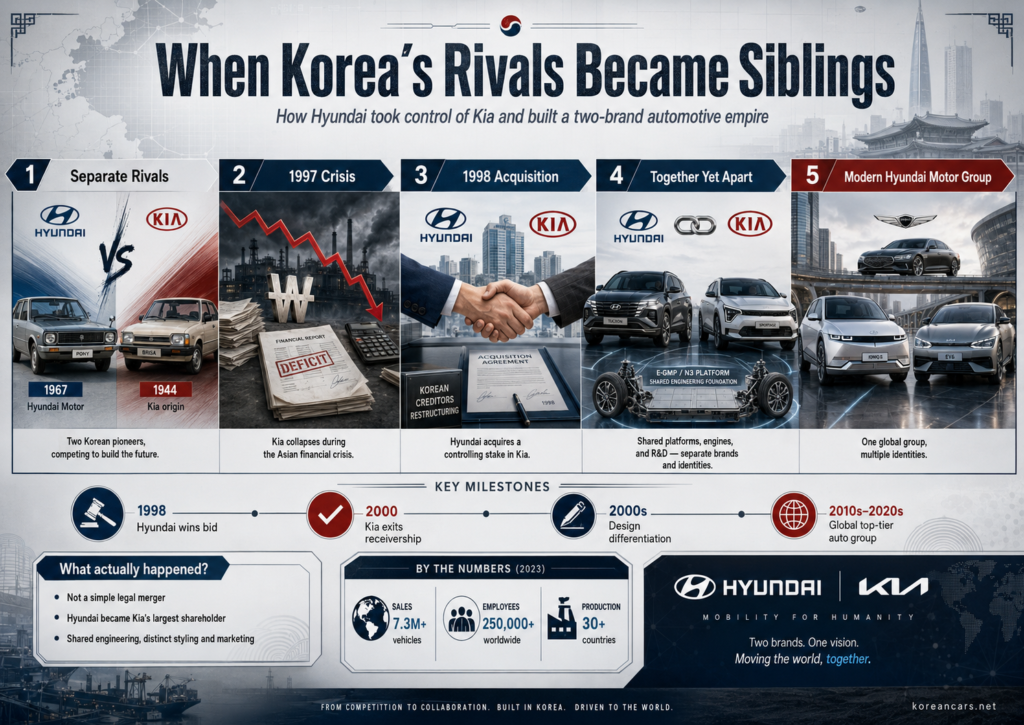
Today, park a Hyundai beside a Kia and the relationship can be obvious to somebody who knows what lies underneath.
A Hyundai Tucson and Kia Sportage may share engineering.
A Hyundai Santa Fe and Kia Sorento can use related powertrains.
The Hyundai IONIQ 5 and Kia EV6 ride on the same E-GMP electric architecture.
Engines, transmissions, electronics and suppliers frequently cross the corporate boundary.
Yet walk into a Kia dealership and it does not feel like a Hyundai dealership.
The logos are different.
The design language is different.
The marketing is different.
The product personalities are deliberately different.
And legally, they are still separate companies.
That unusual arrangement grew from one of the most chaotic moments in South Korean economic history.
Hyundai did not peacefully merge with a healthy Kia after years of strategic negotiations.
Kia effectively collapsed.
Its creditors took control.
The company entered court receivership.
South Korea was simultaneously undergoing the greatest financial crisis of its modern industrial era.
Several of the world’s largest automobile manufacturers then competed for the remains.
And eventually Kia’s greatest domestic rival—Hyundai—won.
Before 1997, Hyundai and Kia Were Competitors
To understand how dramatic the acquisition was, it is important to remember that Hyundai and Kia did not originate together.
Kia was actually older.
Its predecessor was established in 1944, initially manufacturing bicycle components. It progressed through bicycles, motorcycles, three-wheeled trucks, commercial vehicles and eventually passenger cars.
Hyundai Motor Company did not appear until 1967.
The companies therefore developed as independent competitors.
Hyundai built the Pony.
Kia built the Brisa.
Hyundai expanded through vehicles such as the Excel, Sonata and Accent.
Kia returned aggressively to passenger cars with the Pride, then developed the Sephia, Sportage, Credos and other models.
By the 1990s, Hyundai was South Korea’s dominant automaker, while Kia had become the country’s second major independent automotive force.
Kia’s problem was not a lack of technological ambition.
It may have been too much ambition for its financial resources.
Kia Had Been Spending Heavily to Become Independent
During the early 1990s, Kia was trying to move away from dependence on foreign engineering.
The Sephia represented its first independently developed passenger-car programme.
The Sportage placed Kia unusually early into what would become the enormous compact-SUV market.
International exports expanded.
Factories expanded.
New engines and models required development.
Kia even acquired Lotus Elan M100 tooling and produced the low-volume Kia Elan sports car in Korea.
All of this required enormous amounts of capital.
Kia’s own historical account acknowledges that rapid growth, new-model development and production expansion created a severe financial burden before the Asian financial crisis even fully arrived.
Kia was becoming a more serious automaker.
Its balance sheet was simultaneously becoming more vulnerable.
July 1997: Kia Hits the Wall
The crisis became impossible to ignore in July 1997.
Kia entered a court-arranged standstill programme intended to prevent immediate default proceedings while creditors attempted to stabilize the company.
By October, Kia had been placed under court receivership.
The timing could hardly have been worse.
What became known internationally as the Asian financial crisis, and in Korea simply as the IMF crisis, was spreading through the Korean economy.
Credit tightened dramatically.
Highly leveraged companies suddenly found refinancing extraordinarily difficult.
Asset values fell.
Domestic automobile demand collapsed.
And the weaknesses of Korea’s debt-heavy chaebol system became painfully visible.
Kia was among the highest-profile corporate casualties.
At the time of its failure, contemporary reporting placed Kia and Asia Motors’ combined obligations in the billions of dollars, with estimates varying according to what liabilities were counted. The Washington Post reported that creditors were owed at least $8 billion and possibly as much as $12 billion when Kia failed.
This was not a temporary bad quarter.
Kia could no longer continue independently without an enormous restructuring.
Koreans Tried to Save Kia
Kia’s collapse had an emotional dimension inside South Korea that is easy to miss from a purely financial description.
The company had spent decades producing bicycles, Bongo trucks, Pride hatchbacks and other vehicles closely associated with ordinary Korean life.
As bankruptcy approached, civic organizations, labour groups and public figures participated in what became known as the “Save Kia” movement.
There were campaigns encouraging Koreans to buy Kia vehicles, public petitions and celebrity participation in advertisements supporting the company.
But consumer loyalty could not erase billions of dollars of debt.
Kia needed new ownership.
The Government and Creditors Decide Kia Must Be Sold
By May 1998, the process of selling Kia to an outside buyer was moving forward.
This placed one of Korea’s largest industrial companies effectively on the auction block.
And the potential buyers were not small opportunistic investors.
They included some of the biggest names in the global automobile industry.
Ford had a particularly interesting position.
Ford and Mazda already had a long relationship with Kia through the Pride/Festiva programme, and Ford and Mazda together owned approximately 16.9 percent of Kia when the company collapsed.
Ford therefore had both historical experience with Kia and an existing financial interest in the company.
There was a plausible alternate future in which Kia might have become significantly more closely integrated with Ford rather than Hyundai.
Almost Everyone Wanted a Look at Kia
The first major bidding process attracted a remarkable field.
Contemporary Korean reporting identified Hyundai, Daewoo, Samsung and Ford as serious bidders, while General Motors and Chrysler had also examined the process before withdrawing.
Think about how different Korean automotive history could have become depending upon the outcome.
A Ford-owned Kia might have become Ford’s major Asian manufacturing and development operation.
A Daewoo-Kia combination could have created a gigantic domestic competitor to Hyundai.
Samsung could have dramatically accelerated its attempt to establish itself as a Korean automotive power.
Instead, the first auction became a mess.
Bidders disagreed with the valuation.
Debt write-offs became central to the negotiations.
Several offers failed to satisfy the conditions imposed by creditors.
The first attempt ended without a successful sale.
Kia remained in limbo.
Nobody Wanted Kia’s Debt Along With Kia
This was the fundamental acquisition problem.
Buying Kia’s factories, engineers, product programmes and dealer networks could be attractive.
Buying all of Kia’s liabilities was something else entirely.
Any purchaser would need creditors to absorb substantial losses.
The disagreement was therefore not simply:
How much is Kia worth?
It was:
How much of the old Kia’s debt should disappear before somebody takes responsibility for what remains?
This question repeatedly disrupted the auction process.
The Washington Post reported that two attempts failed because potential acquirers sought debt write-offs larger than creditors were initially willing to accept.
That helps explain why even enormous international manufacturers approached the acquisition cautiously.
A cheap purchase price is not cheap if billions in liabilities come attached.
Hyundai Decides Scale Is the Answer
Inside Hyundai, the argument for acquiring Kia was strategic.
Hyundai and Kia together would create something South Korea had never previously possessed:
A Korean automobile group with genuinely global scale.
Kia’s official history attributes the successful Hyundai bid particularly to the conviction of Hyundai founder Chung Ju-yung and automotive leader Chung Mong-koo. Their view was that economies of scale were becoming essential if Korean manufacturers expected to compete globally.
Automotive development was becoming increasingly expensive.
Crash testing.
Emissions development.
Powertrain engineering.
Research facilities.
Factories.
Electronic systems.
Dealer networks.
International homologation.
A company selling two million vehicles can spread those costs across many more units than a company selling several hundred thousand.
Hyundai saw that Kia’s greatest weakness—its financial vulnerability—could become Hyundai’s greatest strategic opportunity.
Ford Appeared to Be the Obvious Rival
Ford had money.
International prestige.
Technology.
Existing Kia ownership.
And an established relationship with the Korean company.
Many observers therefore expected Ford to prevail.
The final bidding produced a surprise.
According to contemporary reporting, Ford was disqualified because the value it assigned to Kia’s commercial-vehicle affiliate Asia Motors did not satisfy the auction’s requirements.
Ford publicly expressed disappointment, arguing that it believed it could have offered a strong strategic fit.
But the auction moved on.
Hyundai emerged as the preferred purchaser.
October 1998: Hyundai Wins
In October 1998, Hyundai Motor was selected as the final acquirer following the international bidding process.
The decision was controversial.
Some observers had hoped the Kia sale would bring large amounts of foreign investment into South Korea during a period when the government was attempting to demonstrate greater openness to international capital.
Instead, Korea’s largest automaker was acquiring Korea’s failed second-largest automaker.
Critics worried that the deal would create excessive domestic concentration.
Supporters saw something very different:
A Korean automotive champion large enough to confront Toyota, Ford, General Motors and Volkswagen internationally.
That debate would continue for years.
But Hyundai had won.
December 1, 1998: The Deal Becomes Real
Hyundai signed the formal takeover agreement around the beginning of December 1998.
The agreement called for roughly 1.18 trillion won, approximately $944 million at the time, to secure a combined 51 percent controlling stake in Kia Motors and Asia Motors.
The initial acquisition was structured through Hyundai and other Hyundai Group companies rather than simply one cheque from Hyundai Motor alone.
Contemporary Korean reporting described a consortium involving Hyundai Motor, Hyundai Heavy Industries, Incheon Steel, Hyundai Development Company and Hyundai financing interests.
That structure makes sense when placed in the context of the old Hyundai conglomerate.
At that point, Hyundai Motor itself had not yet separated from the original Hyundai Group.
Kia was therefore initially being absorbed into the broader Hyundai chaebol.
That arrangement would change almost immediately.
Hyundai Did Not Simply Receive 51 Percent of the Old Kia
The acquisition only worked because creditors simultaneously restructured Kia’s enormous debts.
Without that restructuring, Kia would likely have been financially unviable regardless of who purchased the shares.
Hyundai was therefore not simply buying a functioning company at a bargain price.
It was participating in a much larger rescue involving creditor losses, new capital, corporate restructuring and new management.
The distinction matters.
The Kia that emerged after 1998 was financially and organizationally different from the Kia that had collapsed.
The acquisition effectively provided an opportunity to rebuild the company rather than merely change the name on the chairman’s office.
Chung Mong-koo Becomes the Central Figure
Another major development occurred around the same period.
Chung Mong-koo, Chung Ju-yung’s eldest surviving son, increasingly consolidated his position over Hyundai’s automotive operations.
Kia’s own history credits him with driving the restructuring and integration that followed the acquisition.
This coincided with the larger Hyundai family succession struggle described in the previous article.
Chung Mong-hun would inherit leadership of the remaining Hyundai Group.
Chung Mong-koo would effectively build his own automotive empire around:
Hyundai Motor + Kia.
The acquisition therefore arrived at exactly the moment Hyundai Motor itself was preparing to leave the old Hyundai conglomerate.
January 2000: Kia Escapes Court Receivership
The turnaround happened surprisingly quickly.
Kia officially emerged from court receivership in January 2000, only about fifteen months after Hyundai’s acquisition.
That was an important psychological milestone.
Kia was no longer an insolvent company being kept alive by creditors.
It could begin operating as an ordinary automobile manufacturer again.
But the central strategic question remained:
What exactly was Hyundai going to do with it?
Hyundai Had Three Possible Choices
There were essentially three paths available.
Hyundai could have eliminated Kia and absorbed its factories into Hyundai Motor.
It could have kept Kia alive as a cheap secondary badge selling lightly modified Hyundais.
Or it could create something more unusual:
Two companies that shared expensive engineering but deliberately competed with each other.
Hyundai chose the third.
Kia eventually summarized the philosophy beautifully:
“Together Yet Apart”
Kia’s official history says the post-acquisition companies adopted a “together yet apart” strategy: Hyundai and Kia would cooperate and compete simultaneously, sharing platforms and resources while preserving distinct identities through differentiated design and products.
This became perhaps the most important strategic decision in the entire acquisition.
Because Hyundai did not want Kia simply to become Hyundai with another badge.
The First Integration Was Under the Skin
The expensive parts were the obvious place to cooperate.
Vehicle platforms.
Powertrains.
Transmissions.
Components.
Engineering facilities.
Suppliers.
Research.
Testing.
Purchasing.
Sharing those resources could dramatically lower development cost.
Instead of Hyundai spending billions developing one midsize platform while Kia separately spent billions developing another technically similar platform, one engineering programme could support both brands.
The customer might see two cars.
The engineering organization could see one underlying family.
The 2000 Kia Optima Shows the Model
The Kia Optima, introduced in 2000, became one of the earliest clear demonstrations of the new strategy.
Kia describes it as its first D-segment sedan launched after joining Hyundai Motor Group.
It shared its basic platform with Hyundai, but Kia deliberately gave it different styling and positioning.
That relationship would become increasingly familiar.
Hyundai develops one interpretation.
Kia develops another.
They share what customers do not necessarily care about seeing.
They differentiate what customers do care about seeing.
This sounds obvious now.
At the time, it was a major organizational challenge.
Sharing Too Much Could Destroy Kia
The danger was badge engineering.
Automotive history contains many examples of corporate groups taking one vehicle, changing the grille, installing another badge and pretending the result represents another brand.
Customers usually notice.
And when they do, the weaker brand loses its reason to exist.
Hyundai therefore needed enough commonality to gain economic efficiency without making Kia redundant.
The mechanical integration came relatively quickly.
The true differentiation took considerably longer.
Hyundai Motor Group Is Born
Then another enormous corporate event changed the meaning of the acquisition.
During 2000, Hyundai Motor’s automotive operations separated from the old Hyundai Group.
The newly independent automotive organization became what is now known as Hyundai Motor Group. Kia’s official corporate history directly connects Kia’s integration with the formation of this new automotive group.
The chronology is remarkable.
In 1997:
Kia collapses.
In 1998:
Hyundai acquires Kia.
In 2000:
Kia leaves receivership.
And also in 2000:
Hyundai Motor itself leaves the old Hyundai empire.
The two former Korean competitors were effectively beginning a new corporate life together.
Hyundai Motor Group Was Almost Born From the Kia Acquisition
This is an important way to think about it.
Hyundai Motor Company existed long before Kia joined it.
But the broader Hyundai Motor Group identity became meaningful precisely because Hyundai now had more than one major automobile company to organize.
Hyundai was no longer simply a manufacturer with related suppliers.
It was becoming a multi-brand automotive group.
That distinction would eventually become extremely important.
Hyundai.
Kia.
Later Genesis.
All could use common industrial resources while targeting customers differently.
Asia Motors Was Part of the Deal Too
Kia’s acquisition also included Asia Motors, an important commercial-vehicle manufacturer associated with Kia.
Asia Motors had produced trucks, buses and off-road vehicles and had become deeply connected with Kia before the financial crisis.
Hyundai’s winning acquisition therefore involved more than Kia passenger cars.
It added commercial-vehicle capability and manufacturing assets as well.
Eventually the Asia Motors identity disappeared, with its operations and products incorporated into Kia.
That is an interesting contrast.
Hyundai preserved Kia because Kia possessed enough brand value and scale to justify independence.
It did not preserve every brand inside Kia’s previous corporate structure.
Kia Started Recovering Before Hyundai Could Fully Reinvent It
One misconception is that Hyundai purchased a completely dead company and immediately supplied all of the products that saved it.
Kia still possessed considerable engineering capability when it collapsed.
The Carnival, introduced amid the financial crisis in early 1998, used Kia’s independently developed 2.9-litre diesel engine and became a significant domestic success.
Kia credits Carnival, Carstar and Carens with playing important roles in rebuilding demand during the company’s recovery.
This reinforces an important point from the Kia history article:
Kia failed financially.
It had not stopped knowing how to build cars.
Hyundai acquired valuable engineers, factories, intellectual property and products—not merely a distressed badge.
The Acquisition Created Economies of Scale Almost Immediately
Imagine two independent manufacturers each negotiating with the same supplier.
Hyundai orders one million units.
Kia orders several hundred thousand.
Separately, each negotiates its own price.
Together, the purchasing organization suddenly represents substantially greater volume.
The same principle applies to engineering.
One transmission programme can feed several models.
One engine family can appear across multiple brands.
One crash-development programme can support related architectures.
One supplier can build modules for both.
Over time, those economies of scale became one of Hyundai Motor Group’s greatest structural advantages.
The Group could offer an enormous range of vehicles without independently engineering every component for every badge.
Yet Hyundai and Kia Were Still Allowed to Fight
This might be the cleverest part.
Rather than organizing the brands so that Kia always remained clearly inferior to Hyundai, Hyundai Motor Group increasingly allowed overlap.
A customer shopping for a Hyundai could realistically decide that the equivalent Kia was better.
And vice versa.
That creates internal pressure.
Kia designers must persuade the customer away from Hyundai.
Hyundai engineers and product planners know Kia is sitting across the showroom landscape trying to do the same thing.
The brands therefore cooperate underneath and compete above.
That is precisely what “together yet apart” means.
Euisun Chung Eventually Makes the Separation Much Clearer
The mechanical-sharing strategy worked.
The brand identity initially remained less convincing.
That changed significantly after Euisun Chung became president of Kia in 2005 and emphasized design as a strategic differentiator.
Then Kia recruited Peter Schreyer in 2006.
Schreyer’s tiger-nose design language gave Kia a recognizable visual identity increasingly separate from Hyundai. Hyundai Motor Group later elevated Schreyer to group-wide design leadership, illustrating how talent brought into one brand could ultimately benefit the wider organization.
The acquisition had therefore evolved.
The first challenge was:
Save Kia.
The second:
Integrate Kia.
The third:
Make Kia different enough to justify keeping it.
Design solved much of the third problem.
Sharing Technology Actually Made More Creative Cars Possible
There is a counterintuitive effect here.
Platform sharing sounds like something that should make automobiles more similar.
It can do the opposite.
If Kia does not need to spend billions developing an entirely independent engine, transmission and basic architecture, more resources can be directed toward:
Styling.
Suspension tuning.
Interior design.
Software.
Features.
Market-specific products.
The expensive invisible engineering creates a foundation.
Brand teams then build different personalities on top.
Modern examples make the logic obvious.
The Hyundai IONIQ 5 and Kia EV6 share Hyundai Motor Group’s E-GMP electric architecture.
Yet visually they appear almost unrelated.
The same industrial ecosystem can therefore create substantial differentiation when designers are actually given freedom.
The Relationship Eventually Became More Than Hyundai Giving Technology to Kia
Early descriptions of the acquisition can create an image of technological knowledge flowing only one way:
Hyundai → Kia.
Modern Hyundai Motor Group does not work so simply.
Technology can originate inside group suppliers.
Kia engineers participate in shared development.
Hyundai teams participate in shared development.
Design organizations remain distinct while group technology becomes common.
Lessons from one brand can influence another.
The architecture is better understood as a network than as Hyundai designing complete vehicles and then handing Kia the leftovers.
That is one reason Kia increasingly stopped feeling subordinate.
Kia Also Gave Hyundai Something Hyundai Did Not Have
Hyundai gained factories, volume and engineering.
But strategically it gained something else:
A second attempt at every major market segment.
Suppose Hyundai’s styling does not appeal to one customer.
Kia might.
Suppose Hyundai’s dealer network is weaker in one location.
Kia can capture the customer.
Suppose one brand develops a conservative reputation.
The other can experiment.
The Group gets two opportunities without requiring two entirely independent engineering organizations.
Eventually Genesis added a third.
This portfolio strategy resembles other successful multi-brand automotive groups, but Hyundai and Kia occupy unusually similar price territories, making their internal competition particularly intense.
Hyundai Did Not Permanently Own 51 Percent
Another common misconception is that Hyundai still owns the same 51 percent stake acquired during the rescue.
It does not.
The ownership percentage subsequently fell as the companies’ capital structures changed.
As of the end of 2025, Kia’s own shareholder disclosure lists Hyundai Motor Company as Kia’s largest shareholder with 35.17 percent of the company’s common shares.
That means Kia is not a wholly owned Hyundai subsidiary.
It remains a separately listed corporation with other shareholders.
Hyundai nevertheless remains its largest single shareholder, and both companies operate as central affiliates within Hyundai Motor Group.
That is why saying simply:
“Hyundai owns Kia.”
is broadly understandable but structurally incomplete.
So Did Hyundai and Kia Actually Merge?
Not in the conventional legal sense.
Hyundai Motor Company and Kia did not disappear into one corporation called Hyundai-Kia Motors.
Kia remained Kia.
Hyundai remained Hyundai.
Separate corporations.
Separate financial reporting.
Separate boards.
Separate brands.
Separate product identities.
What merged far more deeply were portions of their industrial ecosystems.
Engineering.
Platforms.
Purchasing.
Suppliers.
Technology.
Parts.
Research.
Corporate strategy.
The better description is therefore:
Hyundai acquired control of Kia, then integrated Kia into Hyundai Motor Group.
Calling it the Hyundai–Kia “merger” is convenient shorthand, but it hides what actually made the arrangement unusual.
The Marriage Was Also Probably Saved by Timing
Had Hyundai acquired Kia ten years earlier, the outcome might have been very different.
Kia might simply have been absorbed.
But by the late 1990s, Kia had already developed substantial brand recognition, factories, international distribution and technical capability.
Destroying all of that would have wasted much of what Hyundai had purchased.
Likewise, global automotive development costs were increasing rapidly.
Two brands sharing investment made economic sense.
And South Korea desperately needed its automotive industry to survive the financial crisis.
The conditions favoured integration without complete absorption.
The Acquisition Also Reduced Korea’s Automotive Diversity
There was a downside.
Before the crisis, South Korea supported multiple independent automotive groups.
Hyundai.
Kia.
Daewoo.
SsangYong.
Samsung’s new automotive operation.
After the crisis and subsequent restructurings, the landscape became much more concentrated.
Hyundai and Kia together came to dominate the domestic passenger-car market.
Contemporary observers immediately worried about that concentration when Hyundai won the Kia auction.
Those concerns were not irrational.
Internal brand competition does not completely replace independent corporate competition.
Yet the counterargument was that neither Hyundai nor Kia alone possessed the global scale that the combined organization could eventually achieve.
The Global Result Was Enormous
The long-term outcome exceeded what many observers in 1998 probably imagined.
Hyundai Motor Group eventually developed Hyundai, Kia and Genesis into a portfolio capable of competing across mainstream, luxury, performance and electric segments.
By 2023, Hyundai, Kia and Genesis together sold approximately 7.34 million vehicles globally, enough for Hyundai Motor Group to rank among the world’s three largest automotive groups by sales.
That figure puts the original acquisition argument into perspective.
Chung Ju-yung and Chung Mong-koo believed Korea needed scale to compete globally.
Twenty-five years later, the company created by combining Hyundai’s automotive operations with Kia had become precisely the kind of global-scale manufacturer they imagined.
Hyundai Saved Kia—but Kia Also Changed Hyundai
It is easy to describe the relationship entirely as a rescue.
There is truth in that.
Without the 1998 restructuring, Kia might have disappeared, been broken apart or ended up under another manufacturer.
Hyundai provided capital.
Management.
Scale.
Shared technology.
Purchasing power.
And stability.
But over time the relationship became reciprocal.
Kia’s increasing emphasis on design forced greater attention to brand differentiation.
Its successful SUVs expanded the Group’s reach.
Products such as Soul demonstrated stylistic experimentation.
The Stinger demonstrated that Kia could serve as a performance halo.
Telluride dramatically strengthened the Group in North America.
The EV6 gave E-GMP a personality completely different from Hyundai’s IONIQ family.
Kia stopped being merely the company Hyundai rescued.
It became one of the engines driving Hyundai Motor Group itself.
The Greatest Success Was That Kia Never Became Hyundai
This may ultimately be the best measure of the acquisition.
More than a quarter-century after Hyundai took control, Kia still matters as Kia.
Customers do not generally walk into Kia showrooms thinking they are buying a disguised Hyundai.
Designers do not simply reproduce Hyundai bodies with different badges.
Kia now has its own global design philosophy.
Its own EV family.
Its own commercial-mobility strategy.
Its own performance aspirations.
Its own enormous customer base.
That means Hyundai managed something difficult.
It extracted the economic advantages of consolidation without completely destroying the identity of the company it acquired.
From Rivalry to Controlled Rivalry
The relationship can therefore be summarized as an evolution.
Before 1998:
Hyundai versus Kia.
After acquisition:
Hyundai saves Kia.
During early integration:
Hyundai plus Kia.
Later:
Hyundai and Kia.
Today:
Hyundai versus Kia—inside the same group.
That final stage is the interesting one.
The rivalry never completely disappeared.
It was internalized.
One Financial Crisis Created the Modern Korean Auto Industry
The irony becomes even greater when this article is placed beside the Hyundai Group breakup story.
The same financial crisis produced two opposite movements.
Kia lost its independence and moved toward Hyundai Motor.
Hyundai Motor simultaneously moved away from the old Hyundai Group.
One company was being absorbed.
The other was breaking free.
Those events crossed directly around 1998–2000 and produced something new:
Hyundai Motor Group.
That is the organization that eventually gave us Hyundai N, Genesis, E-GMP, the Kia Stinger, EV6, IONIQ 5, Telluride, Palisade, Elantra N and the broader modern Korean automotive ecosystem.
Had Kia survived independently, Korean automotive history would look very different.
Had Ford acquired Kia, it would look different again.
Had Daewoo won the auction, perhaps Korea would have developed two entirely different automotive giants.
Had Hyundai simply closed Kia, an enormous portion of modern KDM culture would never have existed.
Instead, Korea’s two great automotive rivals became corporate siblings.
The Merger That Wasn’t Really a Merger
That is ultimately the strangest part of the Hyundai–Kia story.
Hyundai bought Kia.
But Kia survived.
They combined engineering.
But retained competing design organizations.
They share technology.
But sell against each other.
Hyundai Motor Company is Kia’s largest shareholder.
But it does not own every Kia share.
They belong to the same Hyundai Motor Group.
But they remain separate corporations.
The relationship was born out of financial disaster rather than carefully planned corporate strategy.
Yet the structure that emerged became remarkably effective.
In 1997, Kia’s collapse looked like one of the most humiliating failures in Korean industrial history.
By 1998, Hyundai’s acquisition looked to some critics like the creation of an over-concentrated domestic automobile industry.
From today’s perspective, the same event looks like the beginning of one of South Korea’s greatest global industrial successes.
Hyundai did not make Kia disappear.
It gave Kia access to scale.
Kia gave Hyundai access to another identity.
And together—while remaining deliberately apart—they built an automotive group neither company was likely to have created alone.